
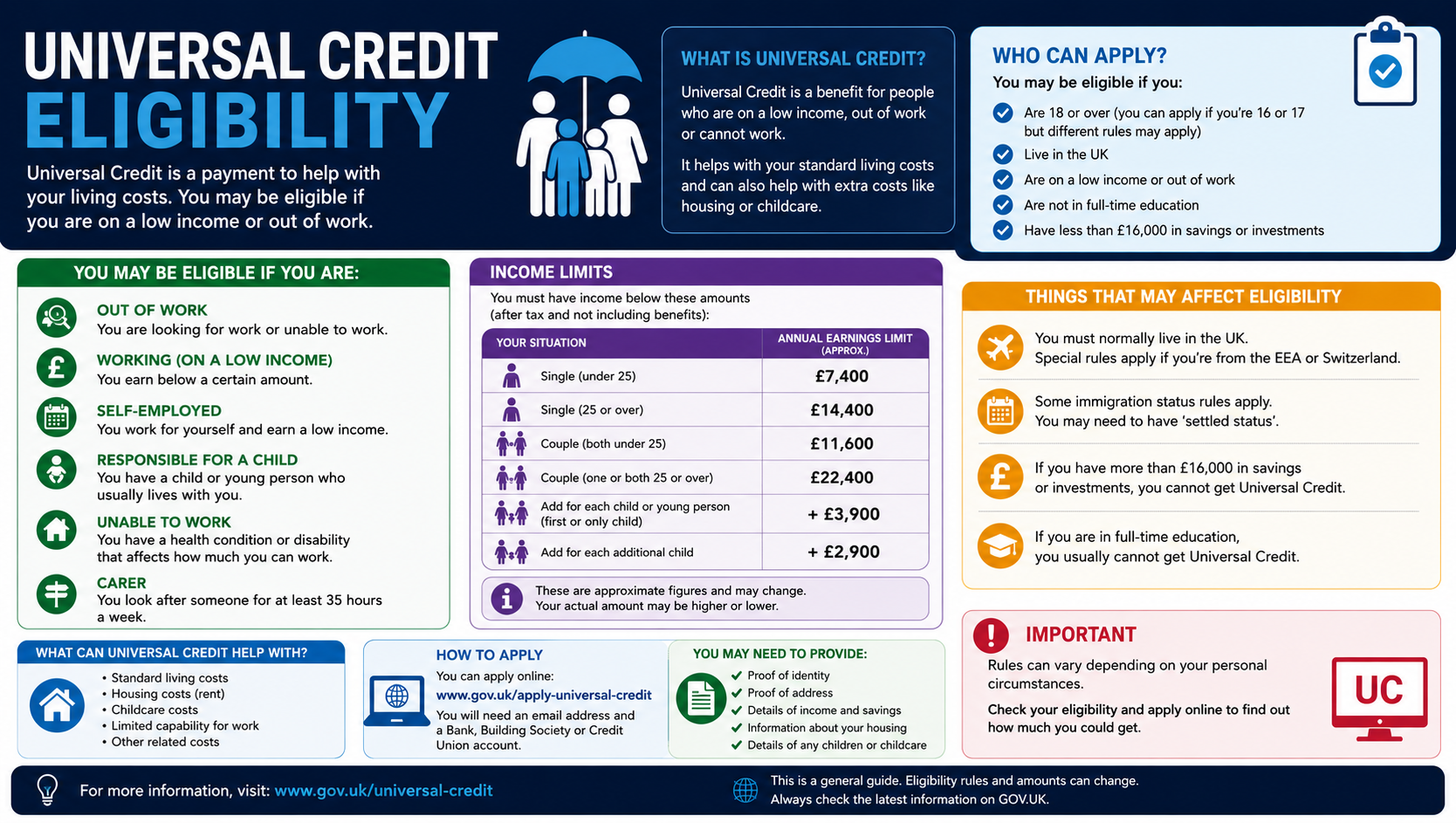
Universal Credit Eligibility If you’ve tried reading the official guidance on Universal Credit, you already know it’s not exactly light reading. Between the savings thresholds, the work-related rules, and the exceptions to the exceptions, it’s easy to close the tab without actually knowing whether you qualify.
This guide strips all of that down to what actually matters. We’ll walk through who can claim Universal Credit in 2026, what could disqualify you, and where the rules changed this year.
Visit Now: https://wishlio.site/
The Basic Rules You Need to Meet First
Before anything else, there are a handful of baseline conditions everyone needs to satisfy:
- You’re 18 or over. There are some exceptions for 16 and 17 year olds, for example if you have a child, are pregnant with less than 11 weeks to go, or can’t work due to illness or disability.
- You’re under State Pension age, currently 66. If you’re older than that, you’d normally look at Pension Credit instead, though mixed-age couples are a special case covered below.
- You live in England, Scotland, or Wales, and can show your main home is genuinely in the UK, Ireland, the Isle of Man, or the Channel Islands. This is what’s known as being “habitually resident.”
- Your immigration status allows you to claim public funds. If you have settled or pre-settled status, indefinite leave, or certain other statuses, you’ll generally meet this condition, though a right to reside may also be required depending on your situation.
Meeting these doesn’t guarantee a payment, since your income and savings still get assessed, but it’s the starting point.
The £16,000 Savings Rule
This is where a lot of claims get turned down without people realising why. If you and your partner’s combined savings, investments, or additional properties add up to more than £16,000, you won’t be eligible for Universal Credit at all, regardless of your income.
Here’s how it breaks down:
- Under £6,000 – your savings don’t affect your claim at all.
- £6,000 to £16,000 – the amount above £6,000 is treated as generating a small monthly income, which reduces your Universal Credit payment.
- Over £16,000 – you’re not eligible, full stop.
What counts toward this limit includes bank accounts, ISAs, Premium Bonds, stocks and shares, and any second property. Your main home, personal belongings, and business assets (if you’re self-employed) don’t count.
How Income and Work Affect Your Eligibility
You don’t need to be unemployed to claim Universal Credit. Plenty of people working part-time or on a low income are still eligible, since the payment is designed to top up earnings rather than replace them entirely.
If you’re working, you may get a work allowance, an amount you can earn before your Universal Credit starts reducing. Once you go over that threshold, your payment tapers down gradually rather than stopping abruptly, so working more hours shouldn’t leave you worse off overall.
Self-Employed Claimants and the Minimum Income Floor
If you’re self-employed and have been trading for over 12 months, the Minimum Income Floor comes into play. In simple terms, the DWP assumes you’re earning at least a certain amount based on the National Living Wage and your expected working hours, even if your actual profit that month is lower. If your real earnings fall short of that assumed figure, your Universal Credit is still calculated as though you’d hit it.
This catches a lot of self-employed claimants off guard, so it’s worth factoring in if your income varies month to month.
Students: Usually Excluded, But Not Always
As a general rule, full-time students can’t claim Universal Credit, since student loans and grants are treated as income and typically reduce any award to zero. But there are recognised exceptions, including if you:
- are responsible for a child,
- have a disability or health condition assessed before your course started,
- are estranged from your parents,
- are a care leaver or in foster care,
- are part of a student couple with a child.
Part-time students who are genuinely available for and actively seeking work can usually still claim, provided they meet the other standard conditions.
Couples and Mixed-Age Households
If you live with a partner, you’ll generally need to make a joint claim, even if only one of you would qualify on your own. Both incomes and both sets of savings are assessed together, which means your partner’s finances can affect your award even if they wouldn’t be eligible individually.
Mixed-age couples are a particular case worth knowing about: if one of you is over State Pension age and the other isn’t, you can’t claim Pension Credit as a couple. Instead, you’ll both need to claim Universal Credit until you’re both over State Pension age, at which point you can apply to switch. That switch isn’t automatic, so it’s something you’d need to action yourselves.
Health Conditions and Disability
If a health condition or disability limits your ability to work, you may be entitled to an additional amount on top of your standard Universal Credit payment, known as the LCWRA element (Limited Capability for Work and Work-Related Activity).
One of the bigger changes in 2026 is that this element now works differently depending on when your claim started. If you were already receiving it before April 2026, or fall under certain protected categories, you keep the higher rate. New claims assessed as LCWRA from April 2026 onward receive a lower rate instead. It’s a meaningful difference, so if this applies to you, it’s worth checking which rate you’d actually fall under rather than assuming.
Read More: Universal Credit Payment Dates 2026 – Complete Monthly Calendar
Carers
If you spend 35 hours or more a week caring for someone with a severe disability, you may be entitled to a carer element added to your Universal Credit. You don’t need to already be receiving Carer’s Allowance to qualify for this, but you do need to have an underlying entitlement to it.
What Changed in 2026
A few updates are worth flagging if you last checked your eligibility before this year:
- The two-child limit was removed from April 2026, meaning you can now get a child element for every child in your household, not just the first two.
- The LCWRA element split into two rates, as covered above, depending on when your claim began.
- Standard allowance rates increased, in line with the government’s commitment to raise them at least alongside inflation.
If your circumstances didn’t fit before, it’s worth checking again, since these changes have shifted eligibility and payment amounts for a fair number of households.
How to Check If You Qualify
Working through all of this manually can get confusing fast, especially if your situation involves a mix of part-time work, savings close to the threshold, or a health condition. A quick way to get a clearer picture is to run your numbers through an eligibility checker, which walks through the same conditions covered here based on your actual circumstances.
Frequently Asked Questions
Can I claim Universal Credit if I’m working full-time? Yes, there’s no rule against working full-time while claiming. What matters is your overall income once your work allowance and taper rate are applied, not the number of hours you work.
Will my partner’s income affect my Universal Credit claim? Yes, if you live together as a couple, you’ll usually make a joint claim, and both incomes and savings are assessed together, even if your partner wouldn’t qualify on their own.
What happens if my savings go over £16,000? You’ll no longer be eligible for Universal Credit while your combined savings stay above that threshold. Once they drop back below it, you can reapply.
Can students claim Universal Credit? Generally no, unless you fall into a recognised exception, such as having a child, a disability, or being a care leaver. Part-time students actively seeking work may also qualify.
Read More: Universal Credit 2026 – New Rules, Payment Rates and Eligibility
Final Thoughts
Universal Credit eligibility comes down to a combination of factors, your age, residency, income, savings, and household situation, rather than a single yes-or-no test. If your circumstances are borderline or you’ve had a change recently, like a new job, a change in savings, or a health diagnosis, it’s worth rechecking rather than assuming the old answer still applies.
FAQ’s
What determines Universal Credit eligibility?
Universal Credit eligibility depends on your age, residency status, income, savings, and household circumstances, rather than any single factor on its own.
Does having savings affect Universal Credit eligibility?
Yes, Universal Credit eligibility is directly affected by savings. If your combined savings exceed £16,000, you won’t qualify, and amounts between £6,000 and £16,000 reduce your payment.
Can I check my Universal Credit eligibility if I’m employed?
Yes, working doesn’t automatically disqualify you. Universal Credit eligibility considers your overall income after work allowances and the taper rate, not just whether you’re employed.
Does my partner’s income affect my Universal Credit eligibility?
Yes, if you live together, your Universal Credit eligibility is assessed jointly, meaning both incomes and savings are combined even if one partner wouldn’t qualify alone.
Are students excluded from Universal Credit eligibility?
Generally yes, though there are exceptions. Full-time students may still meet Universal Credit eligibility requirements if they have a child, a disability, or are a care leaver.
How does self-employment affect Universal Credit eligibility?
Self-employed claimants are assessed using the Minimum Income Floor, which can affect Universal Credit eligibility if actual earnings fall below the assumed minimum income level.
What age do you need to be for Universal Credit eligibility?
You generally need to be 18 or over, though some 16 and 17 year olds may still meet Universal Credit eligibility requirements under specific exceptions.
Does a health condition impact Universal Credit eligibility?
Yes, a health condition can add an extra element to your payment, though the criteria affecting Universal Credit eligibility now differ depending on when your claim started.
Can carers qualify under Universal Credit eligibility rules?
Yes, caring for someone for 35 hours or more a week can qualify you for an additional carer element within the standard eligibility framework.
Did Universal Credit eligibility rules change in 2026?
Yes, several updates took effect in 2026, including the removal of the two-child limit and changes to how the health-related element is calculated.