Healthy Start Scheme If you’re pregnant or have a young child and money feels tight, the Healthy Start Scheme is one of the most useful bits of government support most families never hear about. It’s not as well known as Universal Credit or Child Benefit, but for eligible households it adds up to real money every week, on top of whatever else you’re already claiming.
The tricky part is that the rules aren’t always explained clearly. Some people assume it’s only for families on benefits who have a baby under one. Others think it’s a one-off payment rather than an ongoing weekly amount. Neither is quite right, and getting the details wrong means some families miss out on support they’re actually entitled to, sometimes for months at a time.
This guide walks you through exactly how the Healthy Start Scheme works in 2026 — who qualifies, how much you’ll get, what the payments can be spent on, and how to apply without running into the delays that catch most first-time applicants out.
Visit Now: Mauricette-calculette.fr/
Quick Answer: What Is the Healthy Start Scheme?
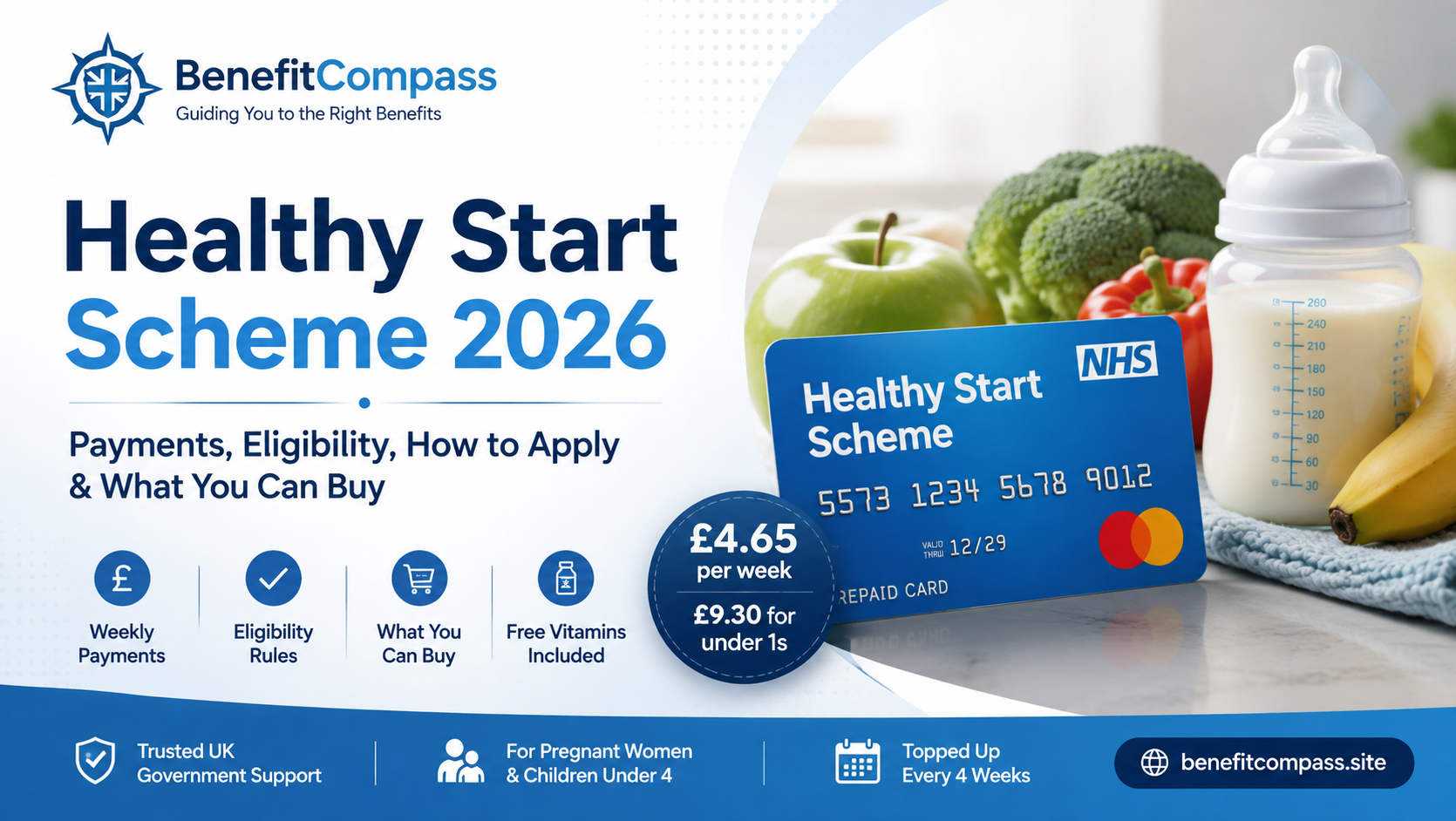
The Healthy Start Scheme is a UK government programme that gives pregnant women and families with children under four a prepaid card loaded with money to spend on healthy food and milk. From April 2026, eligible households receive £4.65 a week per person covered by the scheme, rising to £9.30 a week for a child under one. The card is topped up automatically every four weeks, and eligible families also get free vitamins. Most people qualify by receiving Universal Credit or another qualifying benefit, though pregnant teenagers under 18 can claim regardless of their benefit status.
Why the Healthy Start Scheme Exists
The Healthy Start Scheme has been running in some form since 2006, originally as a paper voucher system before it moved to a prepaid Mastercard in 2021. It operates in England, Wales and Northern Ireland. Scotland runs its own equivalent, called Best Start Foods, with slightly different payment rates and rules.
The idea behind the scheme is straightforward. Pregnancy and the first few years of a child’s life are a critical window for nutrition, but they’re also exactly when household budgets are often stretched thinnest. (Healthy Start Scheme) New parents lose income, childcare costs rise, and food and baby essentials get more expensive. Healthy Start exists to make sure children aren’t missing out on fruit, vegetables, and milk during this period simply because of household finances.
The scheme is run by the NHS Business Services Authority (NHSBSA), which is why you’ll often see it referred to as “NHS Healthy Start” rather than just “Healthy Start.”
Key Terms Worth Understanding First
Before getting into the eligibility rules, it helps to know exactly what a few recurring terms mean, since councils and the NHS Healthy Start site tend to use them without much explanation.
Qualifying benefit – a specific benefit that makes your household eligible for Healthy Start, provided your income also falls under the relevant threshold. Universal Credit is the most common one, but Child Tax Credit, Income Support and income-related ESA also count.
Take-home pay threshold – for Universal Credit claimants, this refers to your household’s earned income from work only, not your total UC award. In 2026, this threshold is £408 or less per month after tax and National Insurance.
Prepaid card – the physical Mastercard your Healthy Start payments are loaded onto. It works like a normal debit card at the till, but only for specific eligible food items.
Top-up – the automatic payment added to your card every four weeks, rather than a weekly transfer. The weekly rate is used to calculate the total, but you won’t see money appear every single week.
Healthy Start vitamins – free vitamin supplements available to eligible pregnant women, breastfeeding mothers, and children under four, separate from the card payments themselves.
With these terms in mind, the eligibility picture below is much easier to follow.
Read More: Disability Living Allowance (DLA) 2026 – Eligibility, Rates & Payment Guide
Why This Scheme Matters More Than It First Appears
It’s easy to underestimate a payment of £4.65 a week. On its own, that might not sound like much. But because it’s paid continuously throughout pregnancy and early childhood, and because you can claim for every eligible child in your household, the total adds up quickly.
A family with a baby under one and a two-year-old, for example, would receive two separate weekly payments at the same time — one at the higher infant rate, one at the standard rate. Over a full year, that’s genuinely significant support, and it comes with no impact on any other benefit you’re claiming.
There’s also a nutritional side to why the scheme matters. (Healthy Start Scheme) Fresh fruit, vegetables, and infant formula are often the first things to get cut from a shopping basket when money is tight. (Healthy Start Scheme) Healthy Start specifically ring-fences spending for these items, which is exactly why the card can’t be used for general shopping, takeaways, or non-food items.
Common Misconceptions About Healthy Start
“It’s only for people on Universal Credit.” Universal Credit is the most common route to qualifying, but it isn’t the only one. Households receiving Child Tax Credit, Income Support, income-based JSA, income-related ESA, or the guarantee element of Pension Credit can also qualify.
“You have to be unemployed to get it.” Not true. Plenty of working families receive Universal Credit and still fall under the earned income threshold, particularly those on part-time or lower-paid work.
“It’s a one-off payment.” Healthy Start is an ongoing weekly entitlement, paid every four weeks onto your card for as long as you remain eligible and your child is under four.
“You lose it as soon as you go back to work.” Your eligibility depends on your household’s take-home pay from work staying under the threshold, not on whether you’re working at all. Many parents in part-time roles remain eligible.
“Pregnant teenagers need to be on benefits to qualify.” Pregnant women under 18 can claim Healthy Start automatically, regardless of whether they receive any qualifying benefit.
A Practical Example
The Ahmed family. Farah is pregnant with her third child and already has a one-year-old and a three-year-old at home. (Healthy Start Scheme) The household receives Universal Credit, and their earned income from work falls comfortably under the £408 monthly threshold.
Because all three — Farah’s pregnancy, her one-year-old, and her three-year-old — are separately eligible, the household receives three payments every week: one for the pregnancy, one at the higher infant rate, and one at the standard rate. All three amounts are combined and loaded onto a single card every four weeks.
This is exactly the kind of household that benefits most from understanding how the scheme stacks per eligible person, rather than assuming it’s a single flat payment per family.
Read More: Employment and Support Allowance (ESA) 2026 – Eligibility, Rates & Claim Guide
Healthy Start at a Glance
| Feature | Detail |
|---|---|
| Who runs it | NHS Business Services Authority (NHSBSA) |
| Where it applies | England, Wales, Northern Ireland |
| Scotland equivalent | Best Start Foods |
| Payment method | Prepaid Mastercard, topped up every 4 weeks |
| Standard weekly rate | £4.65 per eligible person |
| Infant (under 1) weekly rate | £9.30 |
| Free vitamins included | Yes |
| Affects other benefits? | No |
The table above gives you the shape of the scheme, but whether you actually qualify depends on your specific benefit, your income, and your child’s age. Here’s the full picture.
Full Eligibility Criteria: Who Actually Qualifies
You can qualify for Healthy Start if you’re at least 10 weeks pregnant, or you have at least one child under four, and you (or the person claiming benefits for you) receive one of the following:
- Universal Credit – with a household earned income from work of £408 or less per month, after tax and National Insurance
- Child Tax Credit – with an annual household income of £16,190 or less, provided you’re not also receiving Working Tax Credit
- Income Support
- Income-based Jobseeker’s Allowance (JSA)
- Income-related Employment and Support Allowance (ESA)
- The guarantee element of Pension Credit
- Support under Part VI of the Immigration and Asylum Act 1999
- Working Tax Credit run-on – paid for four weeks after your working hours drop below 16 hours a week
Separately, pregnant women and girls under 18 qualify automatically, even if none of the above apply to their household. This is one of the most overlooked parts of the scheme, since many people assume every applicant needs to be on a qualifying benefit.
There’s also an extension scheme for families with no recourse to public funds (NRPF). (Healthy Start Scheme) If you have a British child under four and your family’s take-home pay is £408 or less a month, you may still qualify even if your immigration status would normally exclude you from public funds. This route requires a separate application and supporting documents.
Payment Rates by Household Type
The weekly rate depends on whether you’re claiming for a pregnancy or for a child, and if it’s a child, how old they are.
| Who You’re Claiming For | Weekly Rate | Typical 4-Week Top-Up |
|---|---|---|
| Pregnancy (from 10 weeks) | £4.65 | £18.60 |
| Child under 1 year old | £9.30 | £37.20 |
| Child aged 1 to 4 | £4.65 | £18.60 |
If you have more than one eligible person in your household, you receive a separate payment for each one, combined onto the same card. (Healthy Start Scheme) There’s no cap on the number of children you can claim for, which matters more than it sounds — larger families with several young children can end up receiving a meaningful amount every four weeks once everything is added together.
Worked example: A household with a pregnancy at 20 weeks and a two-year-old would receive £4.65 for the pregnancy plus £4.65 for the child, totalling £9.30 a week, or £37.20 every four-week top-up. Once the baby is born, the pregnancy payment stops and a new, higher payment for the infant begins instead.
Read More: Disability Living Allowance (DLA) 2026 – Eligibility, Rates & Payment Guide
Step-by-Step: How to Apply
Step 1: Confirm you meet the basic criteria. Before applying, check that you’re either at least 10 weeks pregnant or have a child under four, and that you receive one of the qualifying benefits listed above — or that you’re a pregnant woman under 18.
Step 2: Check your benefit award letter. If you’re applying based on Universal Credit, Child Tax Credit, or another means-tested benefit, have your most recent award letter to hand. You’ll need to enter the same figures shown on it, particularly your household’s take-home pay for Universal Credit claims.
Step 3: Apply online or by phone. Most applications are completed through the official Healthy Start website. If you don’t have internet access, or your situation is more complex, you can also apply by phone through the Healthy Start helpline.
Step 4: Provide your details accurately. You’ll need your National Insurance number, details of your pregnancy or children, and confirmation of the qualifying benefit you receive. Small mismatches between what you enter and what’s on your benefit record are one of the most common reasons applications get delayed.
Step 5: Wait for your card. Once approved, your Healthy Start card is sent by post. Processing usually takes a few weeks, so it’s worth applying as soon as you know you’re eligible rather than waiting until money is already stretched.
Step 6: Activate and start using your card. Your card works in any UK shop that accepts Mastercard and sells eligible food and milk. It cannot be used online, for cash withdrawals, or outside the UK.
Step 7: Report any changes in circumstances. If your benefit status, income, or family situation changes, you’re required to update your Healthy Start claim. Payments can stop if you don’t, and you may need to reapply from scratch.
==Read More: Universal Credit Eligibility Checker – Who Can Claim in 2026?==
Real-Life Scenario: Moving from ESA to Universal Credit
Priya has been receiving income-related ESA while pregnant and gets (Healthy Start Scheme) payments as a result. Her baby is born in March, and shortly afterwards her ESA claim ends, with her household moving onto Universal Credit instead.
Because her Healthy Start claim was tied specifically to her ESA award, it doesn’t automatically continue once that benefit stops. Priya needs to reapply for Healthy Start under her new Universal Credit claim, even though her financial circumstances haven’t meaningfully changed and she’s still clearly eligible.
This is a common gap that catches new parents off guard. Payments don’t pause and resume automatically when you switch benefits — they stop, and you need to start a fresh application to get them going again.
What You Can and Can’t Buy
The Healthy Start card is deliberately restricted to specific food categories, which sometimes surprises new applicants expecting more flexibility.
You can buy:
- Plain cow’s milk
- First infant formula, labelled as suitable from birth
- Fresh, frozen, or tinned fruit and vegetables (plain, without added sugar, salt, or fat)
- Fresh, dried, or tinned pulses
You can’t buy:
- Flavoured or follow-on formula
- Fruit juice or smoothies
- Ready meals, even if they contain vegetables
- Toiletries, household items, or anything unrelated to the approved food list
You can split a shop between your (Healthy Start Scheme) card and your regular payment method, but most tills require this as a separate transaction. At self-checkout machines (Healthy Start Scheme), you can usually only split payment between the Healthy Start card and cash, not another bank card, so it’s worth being aware of this before you’re at the till with a full trolley.
Common Mistakes That Delay or Block Applications
- Applying under an outdated benefit. If your qualifying benefit has recently changed — for example, moving from ESA to Universal Credit — your application needs to reflect your current benefit, not the one you were previously receiving.
- Entering the wrong take-home pay figure. For Universal Credit claimants, this specifically means your earned income from work, not your total Universal Credit award. Entering the wrong figure is one of the most common reasons applications are refused.
- Assuming eligibility is automatic. Aside from pregnant teenagers under 18, nobody is automatically enrolled. You need to actively apply, even if you’re already receiving a qualifying benefit.
- Not reapplying after a benefit change. As shown in Priya’s scenario above, payments don’t continue automatically when you switch between qualifying benefits.
- Missing the update when a new child arrives. If you already have Healthy Start for one child and have another, you generally need to notify the scheme so the new child is added, rather than assuming the system will pick this up automatically.
Expert Tips for a Smoother Application
- Apply as early as possible in pregnancy — from 10 weeks — rather than waiting until closer to the birth, since processing takes time
- Keep a copy of your benefit award letter handy in case you’re asked to confirm details during the application
- If your household earned income is close to the £408 threshold, double-check your most recent payslips before applying, since even a small variation can affect the outcome
- Set a reminder to update your claim whenever your benefit situation changes, rather than waiting for a routine review
- If you’re unsure whether your immigration status affects your eligibility, check the NRPF extension route before assuming you don’t qualify
What Happens After Approval
Once your card arrives, the day-to-day mechanics of Healthy Start work a little differently to most benefits, and a few details genuinely catch new claimants off guard.
- Your first top-up isn’t always a full amount. Because payments are calculated from your application date rather than the start of a four-week cycle, your first top-up can be a partial amount covering only the days you were eligible before the next full cycle begins. Don’t assume something’s wrong if your first payment looks smaller than expected — check the date range before contacting the helpline.
- The card doesn’t roll over indefinitely once your child turns four. Payments stop the week of your child’s fourth birthday, not at the end of that month or term. If you have children at different ages, only the ones still under four continue to generate payments.
- Lost or stolen cards need reporting immediately. Your balance isn’t lost, but you’ll need a replacement card issued before you can spend it again, and this can take a week or more to arrive. Reporting it quickly limits the disruption to your food shopping in the meantime.
- Retailers sometimes decline valid transactions. This is almost always because the basket contains an ineligible item, such as flavoured milk or a ready meal, rather than a problem with the card itself. Checking your shopping against the approved list before reaching the till avoids the embarrassment of a declined payment.
Healthy Start vs Best Start Foods: Key Differences
If you live in Scotland, you won’t use Healthy Start at all — you’ll apply for Best Start Foods instead. The two schemes are similar in principle but differ enough in the details that it’s worth understanding the distinction, particularly if you move between nations.
| Feature | Healthy Start (England, Wales, NI) | Best Start Foods (Scotland) |
|---|---|---|
| Weekly rate (pregnancy/child 1–4) | £4.65 | Roughly £5.30 |
| Weekly rate (under 1) | £9.30 | Roughly £10.80 |
| Administered by | NHS Business Services Authority | Social Security Scotland |
| Payment frequency | Every 4 weeks | Every 4 weeks |
| Pregnant under-18s | Automatic, regardless of benefits | Automatic, regardless of benefits |
If you move from Scotland to England, or the other way round, your existing card and claim won’t simply transfer. You’ll need to close one claim and open a new one under the relevant scheme, so it’s worth applying for the new scheme as soon as your address changes rather than assuming continuity.
Frequently Overlooked Information
Healthy Start doesn’t count as income for other benefits. Because it’s specifically ring-fenced for food and milk, it has no effect on your Universal Credit, Child Tax Credit, or any other award you’re receiving. Some parents hesitate to apply out of concern it will reduce other support — it won’t.
You can still claim if you’re self-employed. The £408 monthly threshold applies to earned income regardless of whether it comes from employment or self-employment, though the NHSBSA may ask for slightly different evidence to confirm fluctuating self-employed income.
Backdating is possible in some circumstances. If there’s been a delay in your application being processed, payments can sometimes be backdated to your original eligibility date, but this isn’t automatic — you may need to raise it directly with the Healthy Start team if your top-up doesn’t reflect the full period you were entitled to.
The scheme is under review for expansion. Campaign groups have been pushing for the qualifying age to be extended and for payment values to track food inflation more closely, since current rates still lag behind actual food price rises. It’s worth checking the official Healthy Start website periodically, since eligibility rules and rates can shift with little advance notice.
Key Takeaways
- Scotland uses a separate scheme, Best Start Foods, with different rates and its own application process
- Healthy Start pays £4.65 a week per eligible pregnancy or child aged 1–4, and £9.30 a week for a child under one, loaded onto a prepaid card every four weeks
- You qualify through Universal Credit and several other qualifying benefits, or automatically if you’re a pregnant woman under 18
- The £408 monthly threshold for Universal Credit claimants applies to earned income only, not your total benefit award
- Payments don’t automatically continue if you switch between qualifying benefits — you’ll usually need to reapply
- The card is restricted to specific milk, formula, fruit, vegetable and pulse purchases, and can’t be used online or for cash
Read More: 25 UK Government Grants You Can Claim in 2026
Final Thoughts
The Healthy Start Scheme is easy to overlook, but for eligible families it’s one of the simplest ways to take pressure off the weekly food shop without affecting any other benefit you receive. Once you understand how the payment rates work per person, which benefits count as qualifying, and what the card can actually be spent on, applying becomes far less confusing than the official guidance sometimes makes it seem.
If you’re pregnant or have a child under four and think you might qualify, it’s worth checking your Healthy Start Scheme eligibility properly rather than assuming the criteria won’t apply to you. (Healthy Start Scheme) Between the weekly payments, the free vitamins, and the fact that it doesn’t touch your other benefits, the Healthy Start Scheme is worth a closer look for any household watching food costs closely in 2026.
FAQ’s
How much is the (Healthy Start Scheme) payment in 2026?
From April 2026, eligible households receive £4.65 a week for a pregnancy or a child aged 1 to 4, and £9.30 a week for a child under one. (Healthy Start Scheme) Payments are loaded onto a prepaid card every four weeks rather than paid weekly.
Who is eligible for the Healthy Start Scheme?
You’re eligible if you’re at least 10 weeks pregnant or have a child under four, and you receive a qualifying benefit such as Universal Credit, Child Tax Credit, Income Support, income-based JSA, income-related ESA, or Pension Credit’s guarantee element. (Healthy Start Scheme) Pregnant women under 18 qualify automatically regardless of benefits.
Does Universal Credit automatically qualify you for (Healthy Start Scheme)?
Not automatically — you still need to apply. (Healthy Start Scheme) You qualify through Universal Credit only if your household’s earned income from work is £408 or less a month after tax and National Insurance.
Can I claim (Healthy Start Scheme) if I’m self-employed?
Yes, provided your net earned income falls under the £408 monthly threshold. (Healthy Start Scheme) You may need to provide additional evidence, such as recent accounts, to confirm fluctuating self-employed earnings.
What can I buy with a (Healthy Start Scheme) card?
Plain cow’s milk, first infant formula suitable from birth, fresh, frozen, or tinned fruit and vegetables, and pulses. (Healthy Start Scheme) You cannot buy flavoured formula, juice, ready meals, or anything outside the approved food list.
Does the Healthy Start Scheme affect other benefits I receive?
No. (Healthy Start Scheme) payments are a separate, ring-fenced entitlement and don’t reduce or interact with Universal Credit, Child Tax Credit, or any other benefit you claim.
What happens to (Healthy Start Scheme) payments when my child turns four?
Payments stop the week of your child’s fourth birthday. (Healthy Start Scheme) If you have other eligible children under four, their payments continue as normal.
Do I need to reapply if I move from Universal Credit to another benefit?
Yes, in most cases. (Healthy Start Scheme) eligibility is tied to your current qualifying benefit, so switching between benefits usually means submitting a new application, even if your income hasn’t changed (Healthy Start Scheme).
Is there an equivalent scheme in Scotland?
Yes. Scotland runs Best Start Foods instead of (Healthy Start Scheme), with slightly higher payment rates and its own application process through Social Security Scotland (Healthy Start Scheme).
Can I get (Healthy Start Scheme) if I have no recourse to public funds?
Possibly, through a separate NRPF extension route. If you have a British child under four and your household’s take-home pay is £408 or less a month, (Healthy Start Scheme) you may qualify even if your immigration status would normally exclude you from public funds.