If a health condition or disability makes everyday life harder — getting dressed, cooking a meal, or simply getting out of the house — Personal Independence Payment (PIP rates 2026) could be worth up to £194.60 a week to you in 2026. It is tax-free, it is not means-tested, and you can claim it whether you work or not. Yet thousands of people who qualify never apply, often because the process looks intimidating or because they assume their condition “isn’t serious enough”.
Check the official PIP rates 2026 guidance on GOV.UK for the latest rules.
This guide walks you through everything: the new PIP rates 2026 for 2026, exactly who can claim, how the DWP points system works, what really happens at the assessment, and what to do if your claim is turned down. Every figure below has been checked against gov.uk for the 2026/27 benefit year.
Key takeaways:
- PIP rates 2026 has two parts — daily living and mobility — each paid at a standard or enhanced weekly rate.
- From April 2026 the rates are £76.70 / £114.60 (daily living) and £30.30 / £80.00 (mobility), worth up to £194.60 a week combined.
- PIP rates 2026 is not means-tested: your income, savings and employment status do not affect it, and it is tax-free.
- You claim by phone on 0800 917 2222, then complete the “how your disability affects you” form and usually attend an assessment.
- If refused, challenge it: around 68% of tribunal appeals succeed.
PIP rates 2026: What is PIP rates 2026?
Personal Independence Payment is a UK benefit for people aged 16 or over who have a long-term physical or mental health condition or disability that makes daily life or getting around difficult. It is paid by the Department for Work and Pensions (DWP) in England and Wales. (If you live in Scotland, you claim Adult Disability Payment instead — the Scottish equivalent with its own rules.)
PIP rates 2026 is designed to help with the extra costs of disability. Crucially, it is awarded based on how your condition affects you, not on the name of your diagnosis. Two people with the same condition can receive different awards — or one can qualify while the other does not — depending on the practical difficulties they face day to day. This is the single most misunderstood thing about PIP rates 2026, and it is also good news: you do not need a rare or severe diagnosis to qualify.
PIP rates 2026 has two components, and you can receive one or both:
- Daily living component — for difficulties with everyday tasks such as preparing food, eating, managing medication, washing, dressing, communicating, or engaging with other people.
- Mobility component — for difficulties with planning and following journeys, or with moving around physically.
PIP rates 2026: how much you’ll get
PIP rates 2026 were uprated by 3.8% in April 2026. Each component is paid at either the standard or enhanced rate depending on how many points you score in the DWP assessment (more on the points system below).
| Component | Standard rate (weekly) | Enhanced rate (weekly) |
|---|---|---|
| Daily living | £76.70 | £114.60 |
| Mobility | £30.30 | £80.00 |
| Maximum combined award | £194.60 per week | |
That maximum works out at £778.40 every four weeks, because PIP is paid into your bank, building society or credit union account every four weeks in arrears. A few things worth knowing about the money:
- PIP is completely tax-free.
- It is not affected by your income or savings — you can have a well-paid job and still receive the full rate.
- Receiving PIP can act as a “passport” to other help, including the disability element of Universal Credit, Carer’s Allowance for someone who looks after you, Blue Badge parking, and vehicle tax discounts.
- Want to know exactly when the money lands? See our PIP payment dates 2026 calendar.
PIP rates 2026: Who can claim PIP? Eligibility rules for 2026
You can claim PIP if all of the following apply to you:
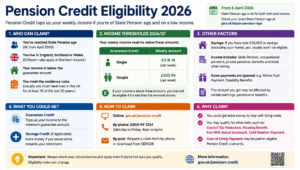
Apply directly on GOV.UK.
- You are aged 16 or over.
- You have a long-term physical or mental health condition or disability — including mental health conditions such as anxiety, depression, ADHD or PTSD.
- You have difficulty with daily living tasks, mobility, or both.
- The difficulties started at least 3 months ago and are expected to last for at least 9 more months (in other words, a 12-month condition).
- You are under State Pension age when you first claim. (If you are over State Pension age, Attendance Allowance is the equivalent benefit.)
- You live in England or Wales, and you have lived there for 2 of the last 3 years. People in Scotland claim Adult Disability Payment instead.
- Children under 16 are covered by Disability Living Allowance (DLA), not PIP.
There is no list of qualifying conditions. Arthritis, back pain, heart disease, diabetes, epilepsy, autism, anxiety, depression, Crohn’s disease, ME/CFS, cancer — any condition counts if it creates the functional difficulties described above. You can also claim PIP while working full-time, while claiming Universal Credit, and alongside most other benefits.
How the DWP scores your claim: the PIP points system
This is the part that decides your award, so it is worth understanding. The DWP assesses you against 12 activities — 10 daily living activities (such as preparing food, washing and bathing, dressing, and managing treatments) and 2 mobility activities (planning and following journeys, and moving around).
For each activity, the assessor chooses a descriptor that best matches what you can do, and each descriptor carries a number of points from 0 to 12. Your points are added up separately for the daily living component and the mobility component:
| Points scored (per component) | What you get |
|---|---|
| 0–7 points | No award for that component |
| 8–11 points | Standard rate |
| 12 or more points | Enhanced rate |
The difficulties must affect you more than half the days across a 12-month period. And here is the community’s most important tip, repeated across every forum and advice site: PIP tests whether you can do each activity reliably — meaning safely, to an acceptable standard, repeatedly, and within a reasonable time. If you can cook a meal once but it wipes you out for two days, or you can walk 50 metres but only in severe pain, that counts as not being able to do it reliably. Describe your bad days, not your best ones, and explain what happens when you try.
How to claim PIP in 2026: step by step
- Start your claim by phone. Call the DWP new-claims line on 0800 917 2222 (Monday to Friday, 8am–5pm). If you use Relay UK, dial 18001 then 0800 917 2222; there is also a British Sign Language video relay service, and you can claim from abroad on +44 191 218 7766. Alternatively, post a letter saying you want to start a PIP claim, with your name and address, to Freepost DWP PIP 1 (no stamp needed). In some areas you can now start the claim online via gov.uk. You will need your National Insurance number, bank details, GP’s name and address, and details of any time spent in hospital or care homes.
- Complete the “how your disability affects you” form (PIP2). After your phone claim you will be emailed a link to the online form, or a paper form will arrive within about two weeks. This is the most important document in your claim: go through each activity, tick the boxes honestly, and use the extra-information boxes to describe what happens when you try — the pain, fatigue, anxiety, or help you need. Return it within one month (call the PIP rates 2026 enquiry line on 0800 121 4433 if you need more time).
- Gather your evidence. You do not need a mountain of paperwork. One clear, recent letter from a GP, consultant, or support worker describing your functional difficulties is worth more than a stack of old hospital letters. Prescription lists, care plans, and a short diary of a typical difficult week all help.
- Attend the assessment (if asked). Not everyone is assessed, but most new claimants are. It takes about an hour and may be at an assessment centre, at your home, by phone, or by video call. The health professional will ask about your daily life and may ask you to do simple movements. You can bring someone aged 16 or over with you, and the session is audio-recorded (you can opt out via the assessment provider beforehand).
- Get the decision. The assessor sends a report to a DWP decision-maker, who writes to you with the award, your points, the payment date, and the review date. The average wait from claim to decision is currently around 16 weeks, so do not panic if it takes months. If you miss the assessment without good reason, your claim will be rejected — always rearrange rather than skip.
Assessments are currently run under the DWP’s Health Assessment Advisory Service, with regional contractors: Maximus (Northern England), Capita (Midlands, Wales and Northern Ireland), Serco (South West and South Central England), and Ingeus (South East, London and East Anglia).
The PIP rates 2026 assessment: what really happens
Assessment day is the biggest source of anxiety in the whole process — it dominates every claimant forum. A few things that genuinely help:
- There are no trick questions, but vague answers lose points. “Can you cook a simple meal?” is not a yes/no question. The answer they need is what it costs you: “I can microwave something, but I can’t safely use the hob because of my tremor, and standing for more than a few minutes leaves me in pain.”
- Talk about variability. If your condition fluctuates, say so clearly, and describe a bad day in detail. Keeping a one-week diary before the assessment gives you concrete examples.
- Bring someone. A friend, family member or support worker can prompt you if you freeze or forget things — assessors see this every day.
- Ask for a recorded assessment if you are worried about the report being inaccurate; recordings make challenges far easier.
- Driving, working or having a pet does not automatically disqualify you. These come up constantly on forums — assessors look at function, and many people who drive or work still score highly on daily living activities.
If the DWP says no: mandatory reconsideration and appeals
Most initial PIP rates 2026 refusals are not the end of the story — a large share are overturned on challenge. If you disagree with the decision:
- Mandatory reconsideration (MR): ask the DWP to look at your claim again within one month of the decision letter (you can ask up to 13 months late if you have a good reason). Do it in writing, going through each disputed activity and explaining which descriptor and points should apply, with any new evidence attached. Do not simply attack the assessor — map your difficulties to the descriptors.
- Tribunal appeal: if the MR does not change the decision, you can appeal to the independent Social Security and Child Support Tribunal using form SSCS1, within one month of the MR notice. The tribunal looks at whether the decision was right at the time it was made.
The numbers are encouraging: roughly 23% of mandatory reconsiderations change the decision, and around 68% of tribunal appeals succeed. One common fear — that challenging your award could reduce it — is, in practice, extremely rare; tribunals far more often increase awards than lower them.
PIP reviews and what is changing in 2026
PIP awards are reviewed periodically rather than lasting forever. From June 2026, new rules extended the gap between reviews: for new claims from people aged 25 and over, the first review now comes after a minimum of 3 years (rising to 5 years at the next successful review). Your award continues while a review is carried out, and you will be contacted by letter with a review form.
Two other 2026 developments are worth knowing about, because rumours swirl online:
- The proposed “4-point rule” is dead. A proposal that would have required at least 4 points in a single daily living activity was dropped from legislation in July 2025. It is not in force.
- The Timms Review — a major independent review of PIP led by Sir Stephen Timms — is due to report in Autumn 2026. No eligibility changes have taken effect, and draft updates suggest PIP will remain a non-means-tested cash benefit. We will update this guide when the final report lands; you can also read our PIP 2026 new rules roundup.
There is also a special rules route for people nearing the end of life: if a medical professional confirms a prognosis of 12 months or less (form SR1), the daily living component is paid at the enhanced rate of £114.60 a week automatically, with no face-to-face assessment.
Frequently asked questions
Can I claim PIP for anxiety, depression or other mental health conditions?
Yes. PIP is about functional impact, not diagnosis. If anxiety, depression, PTSD, ADHD, autism or any other mental health condition makes daily living tasks or getting out difficult — for example, needing prompting to eat, wash or leave the house, or being unable to plan journeys alone — you can qualify. Many successful claims are based on mental health alone.
Can I get PIP if I work?
Yes. PIP is not means-tested and has nothing to do with employment. You can work full-time, be self-employed, or have substantial savings and still receive the full rate. The DWP will not reduce your PIP because you earn.
Can I claim PIP without a formal diagnosis?
Yes, although it is harder. What matters is evidence of how your symptoms affect daily life. GP notes describing your reported difficulties, a support worker’s letter, or a symptom diary can all support a claim while you are waiting for a diagnosis.
How long does a PIP claim take in 2026?
The DWP’s current average is around 16 weeks from starting your claim to receiving the decision. Complex cases and assessment backlogs can make it longer. Your award is backdated to the date you started the claim, so delays do not cost you money overall.
What should I say at the PIP assessment?
Be specific and honest about your worst days. For every activity, explain what happens when you try: the pain, breathlessness, fatigue, anxiety, or help you need — and what the consequences are afterwards. Use the “reliably” test: can you do it safely, to an acceptable standard, repeatedly, and in a reasonable time? If not, say so plainly.
My PIP claim was refused — is it worth appealing?
Very often, yes. Ask for a mandatory reconsideration within one month, in writing, mapping your difficulties to the descriptors. If that fails, appeal to the tribunal — around two-thirds of appeals succeed. Citizens Advice and local welfare rights advisers can help you for free.
I am over State Pension age / I live in Scotland — can I still claim PIP?
New PIP claims are generally for people under State Pension age; if you are over it, claim Attendance Allowance instead. In Scotland, PIP has been replaced by Adult Disability Payment, claimed through Social Security Scotland. And if someone cares for you for 35+ hours a week, they may qualify for Carer’s Allowance.
PIP can be life-changing money — up to £194.60 a week, tax-free, for as long as your condition affects you. If you recognise your own daily struggles in this guide, it is worth starting a claim: call 0800 917 2222, and keep a copy of everything you send. Good luck.