Losing your partner turns life upside down — emotionally, practically and financially. Bills don’t stop, childcare still needs paying, and suddenly a household that ran on two incomes has to run on one. If you’re in this heartbreaking position, Bereavement Support Payment 2026 exists for exactly this moment: a tax-free lump sum plus monthly payments to help you through the first 18 months.
For the complete official rules, see Bereavement Support Payment 2026 on GOV.UK.
Many people miss out because of the strict deadlines — claim within 3 months of the death to receive the full amount — and because the rules changed significantly in 2023, so what you may have heard from friends or family could be out of date. Here’s everything you need to know.
Key takeaways
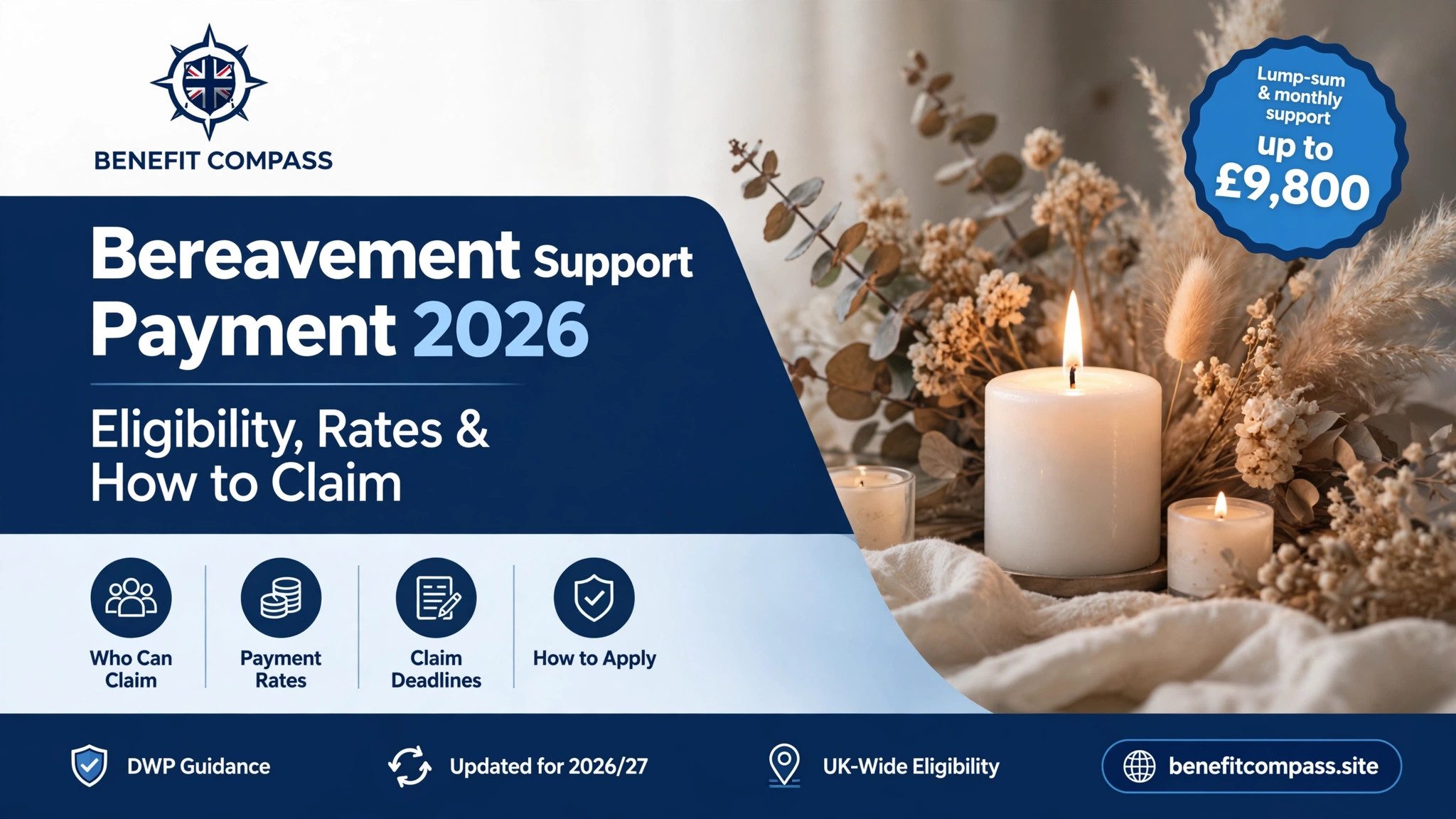
- Bereavement Support Payment 2026 pays a lump sum (£3,500 or £2,500) plus monthly payments for up to 18 months, with maximum totals of £9,800 (higher rate) or £4,300 (standard rate) in 2026.
- Rates are frozen — there is no increase for 2026/27. Bereavement Support Payment 2026 is tax-free and not means-tested, so your income and savings don’t affect eligibility.
- You must have been under State Pension age when your partner died, and your partner must have paid enough National Insurance contributions (waived if they died from a work accident or industrial disease).
- Cohabiting partners with dependent children can claim since a 2023 law change — even if you weren’t married.
- Claim within 3 months of the death for the full amount; after 12 months you usually lose the lump sum, and after 21 months you usually can’t claim at all.
Bereavement Support Payment 2026: What is Bereavement Support Payment 2026?
Bereavement Support Payment 2026 (sometimes shortened to BSP) is a Department for Work and Pensions (DWP) benefit paid to people whose husband, wife, civil partner or cohabiting partner has died. It is designed to help with the immediate financial impact of bereavement — not to replace a lost income long-term, but to give you breathing room while you adjust to your new circumstances.
It replaced three older benefits in April 2017:
- Widowed Parent’s Allowance
- Bereavement Allowance (previously Widow’s Pension)
- Bereavement Payment
If your partner died before 6 April 2017, you may still be assessed under those older rules — but for deaths on or after that date, Bereavement Support Payment 2026 is the benefit to claim.
Bereavement Support Payment 2026 comes in two parts: a one-off lump sum in the first month, followed by up to 18 monthly instalments paid into your bank or building society account. There are two rates, depending on your circumstances — full details are in the rates table below. If you’re also struggling with funeral costs, see our guide to the Funeral Expenses Payment 2026 — who can claim and how much you can get, which covers the separate benefit that can help with burial or cremation fees.
Bereavement Support Payment 2026: Who can claim Bereavement Support Payment 2026?
Use this checklist to see if you’re likely to qualify. You need to meet all of these conditions:
If you also need help with funeral costs, see Funeral Expenses Payment on GOV.UK.
- Age: You were under State Pension age (currently 66) when your partner died.
- Residence: You were living in the UK or a country that pays bereavement benefits.
- Relationship: At the time of the death, you were married to your partner, in a civil partnership with them, or living with them as if you were married (see the cohabiting rules below).
- Your partner’s National Insurance record: Your late partner must have paid National Insurance contributions for at least 25 weeks in a single tax year since 6 April 1975 — or died because of an accident at work or a disease caused by work, in which case the National Insurance condition is waived.
Not sure whether your partner paid enough National Insurance? Claim anyway — the Bereavement Service will check your partner’s record and let you know.
What counts as “living together”?
This is the part that confuses most people. Before 9 February 2023, only married couples and civil partners could claim. After courts found excluding cohabiting parents unlawful, the law changed: since 9 February 2023, you can claim if you were living with your partner as if married and you had dependent children together.
To qualify as a cohabiting partner, one of the following must have applied when your partner died:
- You were getting Child Benefit for a child who lived with you
- You’d been told by the Child Benefit Office that you were entitled to Child Benefit for a child who lived with you, even if you chose not to claim it
- You were pregnant
Note that if your partner — rather than you — was the one getting Child Benefit, you’ll need to make a new Child Benefit claim in your own name before applying for Bereavement Support Payment 2026. If you’re not currently receiving it, our Child Benefit rates 2026 guide — eligibility, payments and how to claim explains how to apply.
Who can’t claim
- You can’t claim if you were divorced from the person who died.
- You can’t claim if you were in prison on the date of the death.
- You can’t claim if you were already over State Pension age when your partner died (you may be able to inherit part of their State Pension instead).
How much will you get in 2026?
The rates are frozen — there is no uprating for 2026/27, so the amounts are the same as in previous years. Which rate you get depends on your circumstances at the time of the death:
| Rate | Who gets it | Lump sum | Monthly payment | Maximum total |
|---|---|---|---|---|
| Higher rate | You were pregnant when your partner died, or you were entitled to Child Benefit for a child who lived with you | £3,500 | £350 for up to 18 months | £9,800 |
| Standard rate | Everyone else who is eligible | £2,500 | £100 for up to 18 months | £4,300 |
Both the lump sum and the monthly payments are tax-free — you don’t declare them on a Self Assessment return. The benefit is also not means-tested, so your earnings and savings have no bearing on whether you qualify or how much you receive.
A few important details about how the payments work:
- The lump sum is paid in the first month after your claim is approved.
- The monthly payments then arrive each month for up to 18 months, paid straight into your bank or building society account — the same account you used for the claim.
- If you claim late (after 3 months), you may receive fewer monthly payments — see the deadlines section below.
- The monthly payments stop if you remarry or enter a new civil partnership during the 18-month period. Simply living with a new partner doesn’t stop them.
How to claim Bereavement Support Payment 2026
You can claim from the date your partner died. There are three ways to apply — pick whichever feels easiest at a difficult time:
Step 1 — Choose how to apply
- Online: Fill in the claim form on GOV.UK — it takes around 15 minutes.
- Phone: Call the Bereavement Service helpline on 0800 151 2012 (England, Scotland and Wales) or 0800 085 2463 (Northern Ireland). If you’re abroad, call +44 (0)191 206 9390 or claim through the International Pension Centre.
- Post: Download the BSP1 claim form from GOV.UK (or pick one up at your local Jobcentre Plus), fill it in and post it to the address on the form.
Step 2 — Have these details ready
- Your National Insurance number
- Your bank or building society account details
- The date your partner died
- Your partner’s National Insurance number
- Your marriage or civil partnership certificate, or evidence of your cohabiting relationship (plus your Child Benefit details if you’re claiming the higher rate)
Step 3 — Wait for a decision
The DWP aims to make the first payment as soon as it can after receiving your application — usually within a few weeks. If your partner’s National Insurance record needs checking, it may take longer, and you can call the Bereavement Service to check your claim’s progress.
Step 4 — Use “Tell Us Once”
When you register the death, the registrar will offer you the free Tell Us Once service, which notifies multiple government departments and services (HMRC, DWP, the passport office, your local council, DVLA and others) in one go. It’s worth using — it saves you making the same painful calls over and over.
If your claim is refused, you have the right to ask for a mandatory reconsideration and, if that doesn’t succeed, to appeal to an independent tribunal.
Claim deadlines — don’t miss out
Many people only learn about Bereavement Support Payment 2026 months after their partner’s death — often too late for the full amount. Here’s how the deadlines work:
- Claim within 3 months of the death — you get the lump sum plus all 18 monthly payments. This is the only way to receive the maximum £9,800 or £4,300.
- Claim after 3 months — you start losing monthly payments. Claims can only be backdated a maximum of 3 months, so every month you delay beyond that point permanently reduces what you’ll receive.
- Claim after 12 months — you usually lose the lump sum altogether.
- Claim after 21 months — you usually can’t claim at all. This is a hard cutoff, though there is one exception: if your partner’s cause of death was only recently confirmed (for example, after an inquest), you may still be able to claim beyond 21 months. Call the Bereavement Service for help.
The single most important takeaway: claim as soon as you feel able to. Grief is overwhelming, and paperwork is the last thing on your mind — but a prompt claim is the difference between the full amount and nothing.
One extra note for cohabiting partners: because the 2023 law change extended eligibility, if your partner died before the change but you couldn’t claim at the time, you may now be able to apply with backdated payments. If you were living together with dependent children and your partner died on or after 6 April 2017, it’s worth checking whether you can claim.
How Bereavement Support Payment 2026 interacts with other benefits
A common worry is whether claiming will reduce your other benefits. Here’s what the rules say:
- For the first 12 months after your first payment: Bereavement Support Payment 2026 does not affect your other benefits at all.
- After 12 months: any money left over from the lump sum could count as savings when means-tested benefits are worked out (such as Universal Credit, Income Support, Housing Benefit or income-based Jobseeker’s Allowance), if it takes your total savings over £6,000.
- The monthly payments themselves do not count as income for means-tested benefits, regardless of how long they last.
It’s also worth knowing that after a partner’s death, Universal Credit has a “bereavement run-on”: your award can continue as if your partner hadn’t died for the assessment period in which they died plus the next two — roughly three months — while you redeclare your circumstances as a single claimant.
If money is tight right now, you may also be eligible for emergency support: the Crisis and Resilience Fund 2026 — who can apply and how it replaces the Household Support Fund covers help with essentials like food, energy bills and clothing. And for a wider overview of what’s available, browse our UK benefits guides.
FAQs
Is Bereavement Support Payment 2026 taxable?
No. Bereavement Support Payment 2026 is tax-free — you don’t pay tax on the lump sum or the monthly payments, and there’s nothing to declare on a Self Assessment return.
Do I need to be on a low income to claim?
No. Bereavement Support Payment 2026 is not means-tested — your income and savings are irrelevant to your eligibility and don’t affect the amount you receive. The only thing that determines your rate is whether you had dependent children or were pregnant when your partner died.
My partner and I weren’t married — can I claim?
You can if you were living together as if married and you had dependent children together (or you were pregnant when your partner died). This rule has applied since 9 February 2023, when the law was changed after courts ruled that excluding cohabiting parents was unlawful. You’ll need to have been getting Child Benefit for a child who lived with you, have been entitled to it, or have been pregnant at the time of the death.
What happens if I miss the 3-month deadline?
You’re not out of luck, but you’ll get less. Claims can only be backdated 3 months, so applying late permanently loses you some monthly payments. After 12 months you usually lose the lump sum, and after 21 months you usually can’t claim at all. One exception: if your partner’s cause of death was only recently confirmed (for example, after a delayed inquest), call the Bereavement Service.
How long does it take to get the first payment?
The DWP aims to make the first payment as soon as it can after receiving your claim, provided you’re eligible. In practice, straightforward claims are usually decided within a few weeks of the DWP receiving your application. If your partner’s National Insurance record needs verifying, it can take longer. You can ring the Bereavement Service to check where things stand.
How are the monthly payments made?
The lump sum and all 18 monthly payments go straight into the bank or building society account you named in your claim — the lump sum first, then the instalments. Payments arrive automatically; you don’t need to do anything each month.
Will it affect my Universal Credit?
Not for the first 12 months after your first payment. After that, leftover lump-sum money could count as savings if your total savings exceed £6,000. The monthly payments never count as income for Universal Credit or other means-tested benefits. Universal Credit also has a three-month “bereavement run-on” after a partner dies.
Does Bereavement Support Payment 2026 stop if I remarry or find a new partner?
The monthly payments stop if you remarry or enter a new civil partnership during the 18-month period. Living with a new partner does not stop them — only a new legal marriage or civil partnership does.
Final thoughts
No benefit can make up for losing your partner, but Bereavement Support Payment can ease some financial pressure while you find your feet — up to £9,800, all tax-free. The crucial thing is not to delay: claim within 3 months of the death, online via GOV.UK, by phone on 0800 151 2012, or by post.
If this guide has helped, take a look at our roundup of 25 UK government grants you can claim in 2026 — you may be eligible for more support than you realise, from help with energy bills to childcare costs. Nobody should leave money on the table at a time like this.