Child Benefit 2026 is the most-claimed family payment in Britain — around 7.55 million families receive it for 12.73 million children. Yet every year, thousands of parents either never claim it or claim it in the wrong way, usually because of confusion about the High Income Child Benefit Charge.
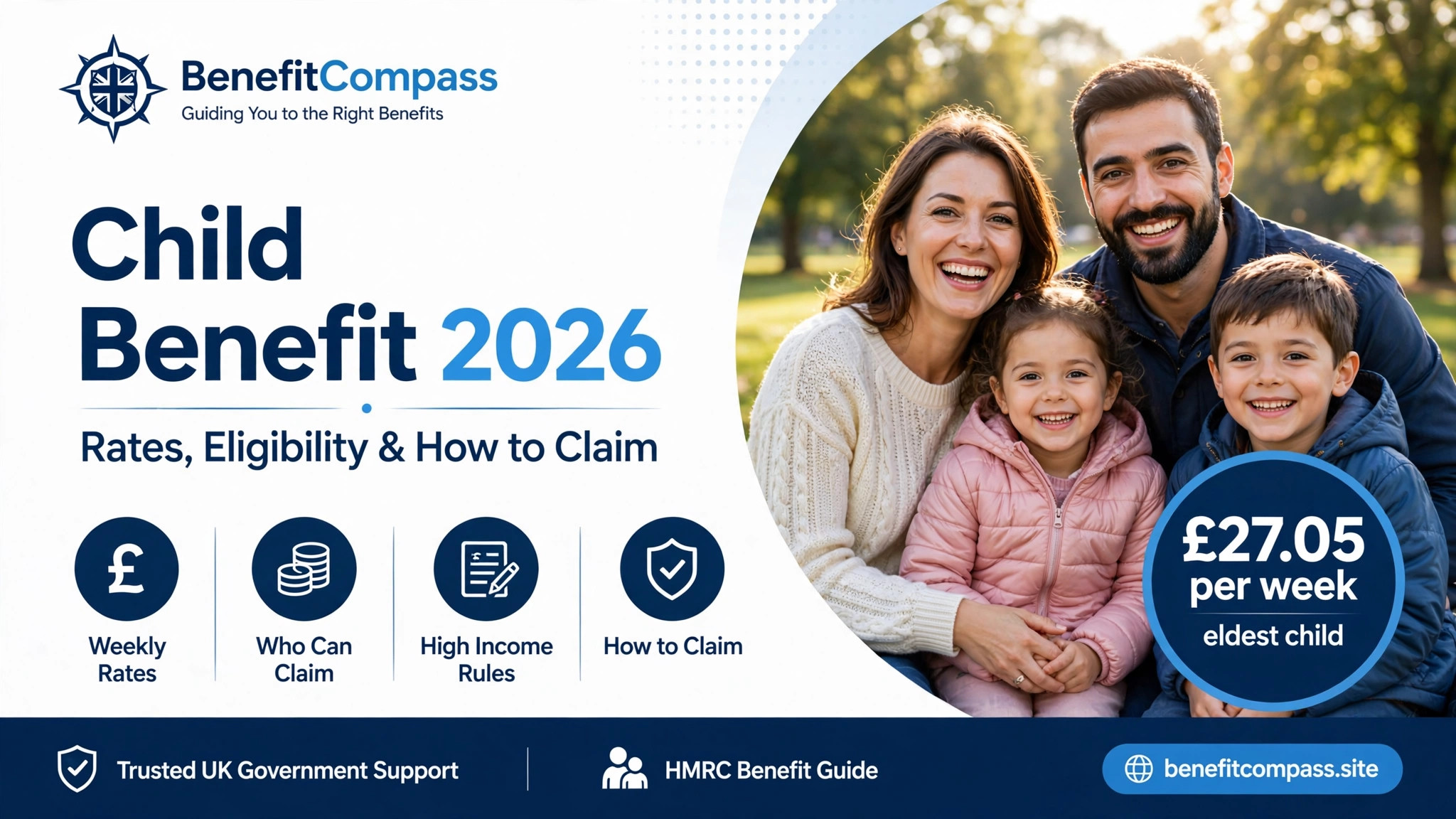
From 6 April 2026 the weekly rate rises to £27.05 for your eldest or only child and £17.90 for each additional child — worth up to £2,337.40 a year for a two-child family. And here is the part most people get wrong: even if you earn too much to keep the money, you should usually still make the claim.
This Child Benefit 2026 guide covers the 2026/27 rates, who can claim, exactly how the High Income charge works, why high earners should claim anyway, and how to apply — plus the backdating rule that catches thousands of parents out.
Key takeaways
- Child Benefit 2026 pays £27.05 a week for the eldest or only child and £17.90 a week for each other child from 6 April 2026.
- It is not means-tested and there is no limit on the number of children you can claim for.
- The High Income Child Benefit Charge claws back the payment when the higher earner’s income is between £60,000 and £80,000.
- You can backdate a claim by up to 3 months — thousands of parents miss out by waiting.
- Always claim, even if you opt out of the payments — the claim protects your State Pension through National Insurance credits.
For the official eligibility rules and current rates, see Child Benefit on GOV.UK.
What Is Child Benefit 2026?
Child Benefit 2026 is a tax-free payment for anyone responsible for bringing up a child in the UK. A few things that distinguish it from most other support:
- It is paid by HMRC, not the DWP. That is why it has its own claim process and its own helpline, separate from benefits like Universal Credit.
- It is not means-tested. There is no savings test and no capital limit, and for the vast majority of families there is no income test either. The only income-related rule is the High Income charge, which works through the tax system rather than reducing the benefit itself.
- There is no two-child limit. Unlike some other family support, Child Benefit 2026 is paid for every qualifying child, however many you have.
- It does not reduce your other benefits. Child Benefit is paid on top of — and ignored by — benefits like Universal Credit.
It is paid every four weeks, usually on a Monday or Tuesday, directly into your bank account.
Child Benefit 2026: Rates for 2026/27
The rates increased on 6 April 2026 in line with inflation:
| 2025/26 | 2026/27 (from 6 April 2026) | |
|---|---|---|
| Eldest or only child — weekly | £26.05 | £27.05 |
| Each additional child — weekly | £17.25 | £17.90 |
| Annual value — one child | £1,354.60 | £1,406.60 |
| Annual value — two children | £2,251.60 | £2,337.40 |
| Annual value — three children | £3,148.60 | £3,268.20 |
(Annual figures are the weekly rate × 52. Three children: £27.05 + £17.90 + £17.90 = £62.85/week × 52 = £3,268.20.)
Who can claim Child Benefit? Eligibility rules
You can claim Child Benefit 2026 if all of the following apply:
- You are responsible for a child — this usually means the child lives with you, or you pay towards their upkeep at least at the level of the Child Benefit 2026 rate. You do not have to be the child’s parent; guardians, grandparents and foster carers can claim.
- The child is under 16 — or under 20 and still in approved full-time education or training (more on this below).
- You live in the UK — subject to the usual residence and immigration-status rules.
Two rules cause most of the confusion:
Only one person can claim for each child. If you are a couple, you must decide which of you claims. This matters more than most people realise, because the claimant receives National Insurance credits towards their State Pension — so it is usually best for the partner who works less, or who is likely to take career breaks, to be the claimant.
You must actively claim — it is never automatic. Even if you already receive other benefits, even if the hospital gave you a leaflet, nothing happens until you make the claim. If you have just had a baby, you may also qualify for a one-off Sure Start Maternity Grant — but that is a separate claim.
Children aged 16 to 19
Child Benefit can continue until your child turns 20 if they stay in approved education or training — typically full-time non-advanced education such as A-levels, or certain approved training courses. You must tell HMRC when your child turns 16 that they are staying in education, or the payments stop. If they leave education, go to university, or start an apprenticeship that pays a wage, tell HMRC straight away.
The High Income Child Benefit Charge (HICBC)
This is the part that puts people off claiming — and the part most people misunderstand.
If you or your partner has an adjusted net income over £60,000 in the tax year, HMRC claws back some or all of the Child Benefit 2026 through the tax system. The clawback is gradual:
- £60,000 or less: no charge, keep it all.
- £60,001 to £79,999: the charge is 1% of the Child Benefit 2026 for every £200 over £60,000.
- £80,000 or more: the charge equals 100% of the Child Benefit — it is all clawed back.
Adjusted net income is your total taxable income before personal allowances, minus things like pension contributions, Gift Aid donations and trading losses. Note the trap: the charge looks at each individual’s income, not the household’s. Two parents earning £59,000 each pay nothing; a single earner on £61,000 pays the charge.
The charge falls on the higher earner — even if it is the other partner who actually receives the Child Benefit 2026 payments.
Worked example
Jade and Liam have two children. In 2026/27 they receive £44.95 a week (£2,337.40 a year). Jade is a stay-at-home parent; Liam’s adjusted net income is £70,000.
Liam is £10,000 over the £60,000 threshold. The charge is 1% × (£10,000 ÷ £200) = 50% of the Child Benefit 2026 — so Liam pays £1,168.70 through the tax system, and the family keeps the other half.
Reducing the charge
Because the charge is based on adjusted net income, anything that legitimately reduces that figure helps — most commonly pension contributions. If Liam above paid £10,000 into his pension, his adjusted net income would fall to £60,000 and the charge would disappear entirely. Salary-sacrifice arrangements through an employer can work the same way.
How you pay it
If the charge applies, you normally pay it through Self Assessment — you must register by 5 October following the tax year, and penalties apply if you needed to register and did not. However, since September 2025, employed people whose only reason for filing is the High Income charge can instead choose to pay it through their PAYE tax code, avoiding a tax return altogether. You can estimate what you might owe using HMRC’s Child Benefit tax calculator.
Alternatively, you can opt out of receiving the payments while keeping the claim itself live (see below) — useful if the charge would take the whole amount.
Why you should still claim — even if you earn over £80,000
This is the single most valuable piece of advice in this guide, and it comes directly from MoneySavingExpert’s Martin Lewis: make the claim even when you know the charge will take all the money back.
A live Child Benefit claim gives you three things that have nothing to do with the weekly payment:
- National Insurance credits. Until your youngest child turns 12, the claimant gets NI credits that count towards the State Pension. Analysis suggests a single missed year could reduce your State Pension by around £329 a year — roughly £6,500 over a typical 20-year retirement. Four missed years could cost over £26,000.
- Your child’s National Insurance number. Children covered by a claim are automatically issued an NI number shortly before they turn 16.
- The right to restart payments. If your income drops below £80,000 later, you can revoke the opt-out and restart payments — going back up to two years in some circumstances.
So the correct move for a high-earning household is: claim Child Benefit 2026, then tick the box to opt out of receiving the payments. You keep the NI credits and the NI number, and nobody owes HMRC anything.
One caution from the community: parents who assumed they were not eligible under the old £50,000 threshold and never claimed at all have found they cannot backdate payments beyond three months when the rules changed in their favour. Since April 2024, parents who missed NI credits can in some cases claim credits back to 2013 — but the sooner you act, the better.
How to claim Child Benefit: step by step
Step 1 — Register the birth. You can usually start the Child Benefit 2026 claim 48 hours after registering your child’s birth (or as soon as a child comes to live with you).
Step 2 — Decide who claims. Remember: only one claimant per child, and the claimant gets the NI credits. In most couples, the lower earner or stay-at-home parent should claim.
Step 3 — Apply online. The fastest route is the online claim at gov.uk (search “claim Child Benefit”). You can also claim by post using form CH2. You will need both parents’ details, the child’s birth certificate or registration details, and your bank details.
Step 4 — Consider the High Income question on the form. If the higher earner’s income is likely to exceed £60,000, you can opt out of payments from the start while keeping the claim — protecting your NI credits without creating a tax bill.
Step 5 — Wait for the decision. HMRC says new claims can take up to 12 weeks to process (longer if you are new to the UK). Payments are backdated to the date of claim — or up to 3 months before it, if you ask.
Step 6 — Tell HMRC about changes. A child leaving education, moving abroad, or a change in who the child lives with — report it promptly to avoid overpayments.
If you are also juggling the costs of a young family, check whether you qualify for the Healthy Start scheme (free vitamins and money for food) and free school meals once your children are at school.
Common problems — and how to avoid them
“We’re separated — who should claim?” The parent the child mainly lives with usually claims. Only one claim per child is allowed; if both parents claim, HMRC will decide based on who has main responsibility. An ex-partner can claim if the children live with them and there is no high earner in their household.
“We both claimed by mistake.” Contact HMRC immediately. Duplicate claims are sorted by deciding which parent has main responsibility — but sort it before overpayments build up.
“I assumed we earned too much, so I never claimed.” This is the classic error, especially for parents whose children were born when the threshold was £50,000. Claim now: you will get payments backdated up to three months, and you may be able to recover NI credits for earlier years.
“My 16-year-old is staying in sixth form.” You must actively tell HMRC — payments do not continue automatically. HMRC usually writes to you before the September after your child turns 16; reply, or the money stops.
“I’m self-employed — what is my adjusted net income?” Your total taxable profit before personal allowances, minus pension contributions and Gift Aid. If it hovers near £60,000, pension contributions before 5 April can be the difference between a charge and no charge.
“We’re new to the UK.” You can claim if you live in the UK and have the right to reside, but processing takes longer and backdating rules still apply — claim as early as you can.
Frequently asked questions
Is Child Benefit 2026 means-tested?
No. There is no test of your savings or capital, and no income test on the benefit itself. The High Income charge is a separate tax charge collected through HMRC — the benefit is still paid in full, then clawed back.
Can I claim Child Benefit 2026 for three or more children?
Yes — there is no cap. You receive £27.05 a week for the eldest and £17.90 for each additional child, however many children you have.
My partner earns £65,000 and I don’t work. Should we still take the payments?
Usually yes. At £65,000 the charge claws back 25% of the benefit, so you still keep 75% — around £1,750 a year for two children. Only above £80,000 is it all clawed back, and even then you should keep the claim (opting out of payments) for the NI credits.
Do I really need to file a tax return just for the High Income charge?
Not necessarily any more. If the charge is your only reason for filing, you can register to pay it through your PAYE tax code instead (available since September 2025). Otherwise, register for Self Assessment by 5 October.
Can Child Benefit 2026 be backdated?
Yes — up to 3 months from the date you claim. That is why Martin Lewis’s warning matters: parents who waited years assuming they were ineligible could only recover three months of payments.
Does Child Benefit 2026 affect Universal Credit or other benefits?
No. Child Benefit 2026 is ignored when calculating Universal Credit and most other means-tested benefits — it is paid on top, not instead.
What counts as “approved education” for 16 to 19-year-olds?
Full-time non-advanced education (such as A-levels or equivalent) and certain approved unpaid training courses. University degrees, paid apprenticeships and part-time courses generally do not qualify.
We’re a high-earning couple and never claimed. Is it too late for the NI credits?
Not necessarily. Since April 2024, parents who missed out can in some cases claim NI credits back to 2013, though time limits apply. Make the Child Benefit 2026 claim now and ask HMRC about the credits — every year you delay narrows your options.
Child Benefit is one of the simplest benefits to claim and one of the easiest to get wrong. The weekly money matters — £1,406.60 a year for one child, £2,337.40 for two — but the hidden value is in the claim itself: the National Insurance credits protecting your State Pension and your child’s automatic NI number. Claim as soon as you can, decide deliberately who the claimant should be, and revisit the High Income position every tax year. Three months is all the backdating the system allows — do not give HMRC a reason to keep the rest.
Figures in this guide are for the 2026/27 benefit year starting 6 April 2026. Rates are set by the government each autumn and we update our guides when they are confirmed. This Child Benefit 2026 guide is worth bookmarking — revisit your High Income position every tax year.