
Pension Credit Eligibility 2026 If you’re waiting on Personal Independence Payment, you already know the drill: the money needs to land on time, because rent, bills, and care costs don’t wait around. Pension Credit Eligibility 2026 work a little differently to other benefits, and if you don’t know how the cycle runs, a bank holiday or a weekend can throw your whole month off.
This guide walks through exactly how Pension Credit Eligibility 2026 are worked out, which bank holidays will shift your payment early, and what to do if the money hasn’t shown up when you expected it.
Visit Now: https://wishlio.site/
How Pension Credit Eligibility 2026 Actually Work
PIP isn’t paid monthly. Pension Credit Eligibility 2026 It’s paid every 4 weeks, which is a detail a lot of people miss when they’re budgeting. Pension Credit Eligibility 2026 That means your payment date shifts slightly across the calendar year, rather than falling on the same date every month like a salary would.
Here’s the basic pattern:
- Your first payment is usually made a few weeks after your claim is approved, covering the period from your original claim date Pension Credit Eligibility 2026.
- From that point, DWP pays you on the same day of the week, every 4 weeks, for as long as your award runs.
- Because a 4-week cycle doesn’t line up neatly with calendar months, your payment date will land on a slightly different date each time — but always the same day of the week.
For example, if your first payment lands on a Tuesday, every payment after that will also land on a Tuesday, roughly every 28 days Pension Credit Eligibility 2026.
Your exact schedule and the last amount paid are shown on your PIP award letter, and you can also check payment history by calling the PIP enquiry line if you’re ever unsure.
PIP Payment Dates 2026 vs Universal Credit: Why They’re Different
This trips a lot of people up, especially if they claim both benefits. Pension Credit Eligibility 2026 Universal Credit runs on a personal monthly assessment period. PIP does not. Here’s the difference laid out simply:
| Feature | PIP | Universal Credit |
|---|---|---|
| Payment frequency | Every 4 weeks | Every calendar month |
| Based on | Day of the week you were first paid | Date you first claimed |
| Number of payments per year | 13 | 12 |
| Means-tested? | No | Yes |
| Affected by earnings? | No | Yes |
The “13 payments a year” point is worth remembering. Because 4-week cycles don’t divide evenly into 12 months, most PIP claimants get 13 payments in a calendar year rather than 12. It’s not extra money overall — your annual entitlement is fixed — but it does mean two payments occasionally land in the same calendar month, which can look confusing on a bank statement if you’re not expecting it.
Read More: How to Apply for Universal Credit – Step-by-Step Guide (2026)
PIP Rates 2026/27: What You’re Actually Being Paid
Before we get into the calendar side of things, it helps to know what amount you should be seeing land in your account. PIP rates increased by 3.8% from 6 April 2026, in line with the wider benefit uprating for the 2026/27 tax year.
Weekly rates from 6 April 2026:
- Daily Living – standard rate: £76.70 per week
- Daily Living – enhanced rate: £114.60 per week
- Mobility – standard rate: £30.30 per week
- Mobility – enhanced rate: £80.00 per week
Since PIP is paid every 4 weeks, here’s what those weekly rates work out to per payment:
| Award combination | Weekly rate | Paid every 4 weeks |
|---|---|---|
| Standard Daily Living + Standard Mobility | £107.00 | £428.00 |
| Enhanced Daily Living + Standard Mobility | £144.90 | £579.60 |
| Standard Daily Living + Enhanced Mobility | £156.70 | £626.80 |
| Enhanced Daily Living + Enhanced Mobility | £194.60 | £778.40 |
If you’re only getting one component, just take the relevant weekly rate above and multiply by 4. The DWP applies the uprating automatically, so there’s nothing you need to do — most claimants notice the higher amount from their first payment on or after 6 April 2026.
The Golden Rule for Weekends and Bank Holidays
This is the part that catches people out every single year. If your usual PIP payment date falls on a Saturday, Sunday, or bank holiday, the DWP moves your payment to the last working day before it — never after.
It feels like a nice surprise when the money turns up early, but it isn’t a bonus. It’s the same amount, just arriving a few days sooner, which means the gap before your following payment stretches out a little longer than usual. Plan your bills around your normal date, not the earlier one, so you’re not caught short later in the cycle.
Read More: How to Apply for Universal Credit – Step-by-Step Guide (2026)
UK Bank Holidays Affecting PIP Payment Dates 2026
Here’s the full list of 2026 bank holidays that could move your PIP payment, along with the likely adjusted date:
| Bank Holiday | Date | Falls On | Payment Likely Moves To |
|---|---|---|---|
| New Year’s Day | 1 January | Thursday | No change (weekday) |
| Good Friday | 3 April | Friday | Thursday 2 April |
| Easter Monday | 6 April | Monday | Thursday 2 April or Friday 3 April |
| Early May Bank Holiday | 4 May | Monday | Friday 1 May |
| Spring Bank Holiday | 25 May | Monday | Friday 22 May |
| Summer Bank Holiday | 31 August | Monday | Friday 28 August |
| Christmas Day | 25 December | Friday | Wednesday 23 December |
| Boxing Day | 26 December | Saturday | Wednesday 23 December |
| Boxing Day (substitute) | 28 December | Monday | Wednesday 23 December |
A few points worth flagging for Pension Credit Eligibility 2026 specifically:
- Easter is a double hit. With Good Friday and Easter Monday sitting either side of the weekend, anyone due a payment between 3 and 6 April will most likely be paid on the Thursday or Friday before.
- June and July run as normal, since there are no bank holidays in either month.
- Christmas needs the most planning. Because Christmas Day falls on a Friday and Boxing Day on a Saturday in 2026, payments due between 25 and 28 December are likely to arrive around 23 December — and the wait until your next payment in late January stretches out further than usual. Budgeting for this in advance makes a real difference.
Since PIP runs on a 4-weekly cycle rather than a fixed monthly date, exactly which payments get shifted depends on your individual payment day. If your day of the week happens to fall on one of the dates above, expect the earlier payment. If it doesn’t, your payment carries on as normal.
How to Check Your Own Pension Credit Eligibility 2026
Since PIP payment dates are personal to you, the calendar above is a guide rather than a guarantee. To check your own dates:
- Look at your PIP award letter, which usually confirms your payment day.
- Check your bank statement history — whatever day of the week your last few payments landed on is the day you should expect going forward.
- Call the PIP enquiry line on 0800 121 4433 if you want confirmation of your next payment date.
- Watch for a DWP letter or text ahead of any bank-holiday-affected payment, confirming the adjusted date.
What to Do If Your PIP Payment Is Late
If the date has come and gone and nothing’s arrived, work through this before assuming something’s gone wrong:
- Wait until the end of the day. Payments can land any time up to midnight depending on your bank, so don’t panic first thing in the morning.
- Check for bank holiday adjustments. Cross-check the calendar above — you may simply be expecting the payment on the wrong day.
- Confirm your bank details are correct and haven’t changed since your last payment.
- Call the PIP enquiry line on 0800 121 4433 (Monday to Friday, 8am–5pm) if nothing has arrived by the next working day.
- Ask about hardship support if a delay is leaving you unable to cover essentials — advisers can sometimes flag urgent cases for faster review.
Can You Change Your Pension Credit Eligibility 2026?
Not really, and this is another point where PIP differs from Universal Credit. Your payment day is set by your original award and isn’t something you can request to move for convenience. If your payment date genuinely doesn’t work for your budgeting — for instance, it lands right before rent is due rather than after — it’s worth speaking to Citizens Advice or a welfare rights adviser about whether an Alternative Payment Arrangement could help, though these are considered case by case.
Read More: Universal Credit Eligibility Checker – Who Can Claim in 2026?
Final Thoughts
Pension Credit Eligibility 2026 follow a simple rule once you understand the pattern: paid every 4 weeks, on the same day of the week, moved earlier whenever a weekend or bank holiday gets in the way. The trickiest stretches of the year are Easter and Christmas, so it’s worth marking those dates in your calendar now rather than finding out the hard way in December. When in doubt, your award letter and bank statement history are the two most reliable ways to confirm your own exact schedule.
FAQs
What is Pension Credit Eligibility 2026?
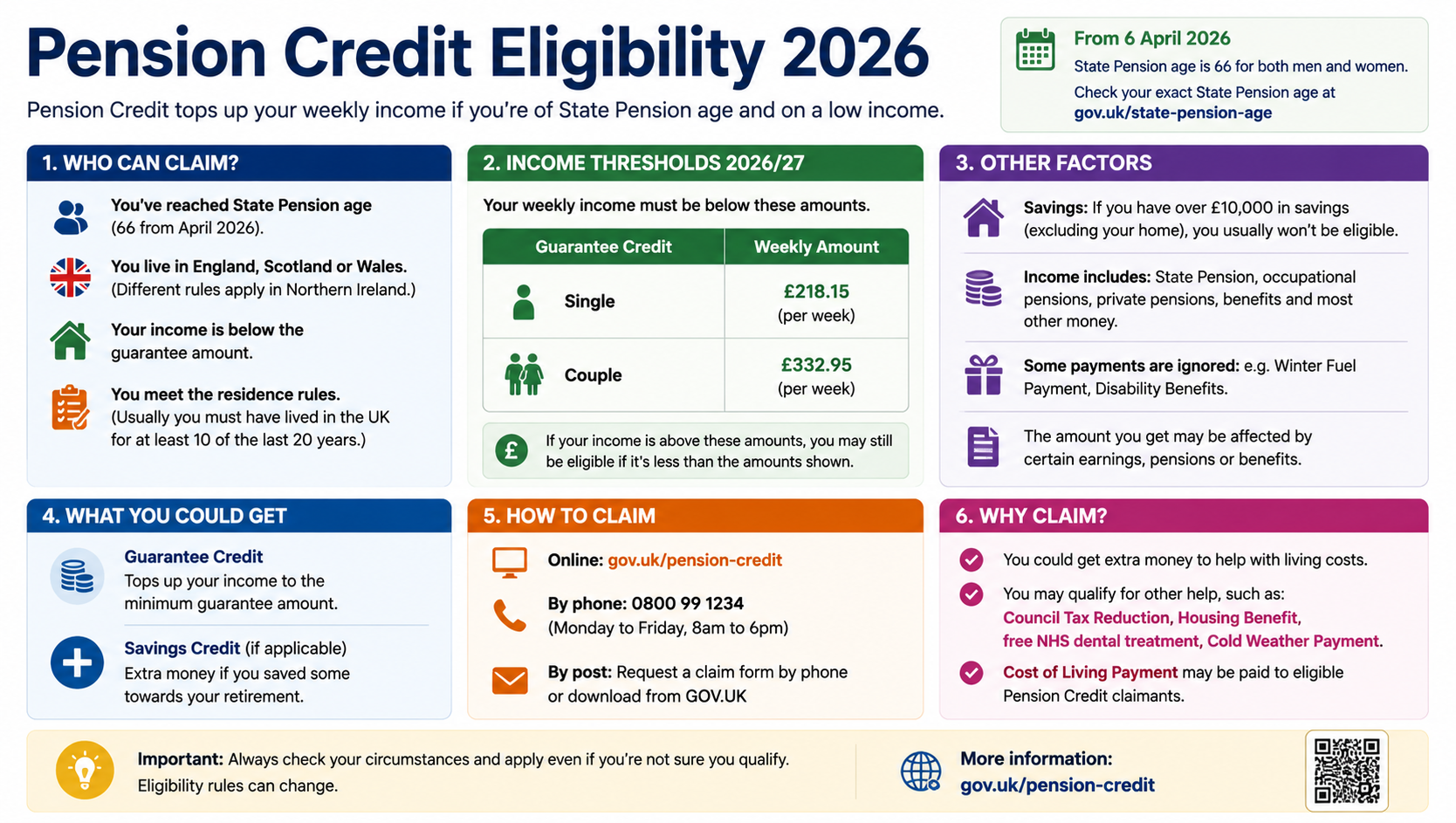
Pension Credit Eligibility 2026 refers to the updated rules and income thresholds that determine who can claim Pension Credit this year. (1)
Who qualifies under Pension Credit Eligibility 2026?
To qualify under Pension Credit Eligibility 2026, applicants must have reached State Pension age and have a weekly income below the set threshold. (2)
Has the income threshold changed for Pension Credit Eligibility 2026?
Yes, the income threshold has been updated as part of Pension Credit Eligibility 2026, so it’s important to check the latest figures before applying. (3)
Can savings affect my eligibility?
Savings above a certain amount can reduce or affect your eligibility, even if you otherwise meet the basic requirements for this year’s rules. (0)
Do I need to be a UK resident to qualify?
Yes, applicants generally need to be living in the UK and meet residency conditions to be considered eligible this year. (0)
How is Pension Credit Eligibility 2026 different from previous years?
Pension Credit Eligibility 2026 includes revised income limits and updated guidance compared to earlier years, so past eligibility doesn’t guarantee current qualification. (4)
Does having a partner affect eligibility?
Yes, if you have a partner, your combined income and savings are usually assessed together when determining eligibility. (0)
What documents are needed to apply?
You’ll typically need proof of income, savings, National Insurance number, and bank details to complete your application. (0)
How can I check my Pension Credit Eligibility 2026 status?
You can check your Pension Credit Eligibility 2026 status using the official government calculator or by contacting the Pension Service directly. (5)
Where can I apply once I confirm eligibility?
Once you understand Pension Credit Eligibility 2026 requirements, you can apply online, by phone, or by post through the official government service. (6)