Attendance Allowance 2026 Attendance Allowance 2026 – Rates, Eligibility and How to Apply
If you’re over State Pension age and a health condition is making daily life harder, Attendance Allowance could be worth thousands of pounds a year — and you don’t have to spend it on “care” at all. Attendance Allowance 2026 It’s one of the most overlooked benefits in the UK, largely because so many pensioners assume their savings or pension income will disqualify them. Attendance Allowance 2026 They won’t Attendance Allowance 2026.
This guide walks through the current Attendance Allowance 2026 rates, exactly who qualifies, how the application actually works, and the mistakes that cause otherwise eligible claims to get turned down Attendance Allowance 2026.
Visit Now: https://wishlio.site/
What Is Attendance Allowance?
Attendance Allowance is a weekly, tax-free payment from the Department for Work and Pensions (DWP) for people who have reached State Pension age and need help with personal care or supervision because of a physical or mental health condition Attendance Allowance 2026.
It’s not designed for one specific illness or disability. Attendance Allowance 2026 Instead, the DWP looks at how your condition affects you day to day — things like washing, dressing, eating, taking medication, or staying safe from falls, confusion, or seizures Attendance Allowance 2026.
A few things make it different from most other benefits:
- It’s not means-tested, so your income, savings, and pension pot make no difference.
- You don’t need to already have a carer. If you live alone and simply struggle without help, you can still qualify.
- It’s completely tax-free and doesn’t affect your State Pension.
- There’s no restriction on how you spend it — taxis, a cleaner, heating bills, or mobility equipment are all fair game.
Attendance Allowance 2026 Rates
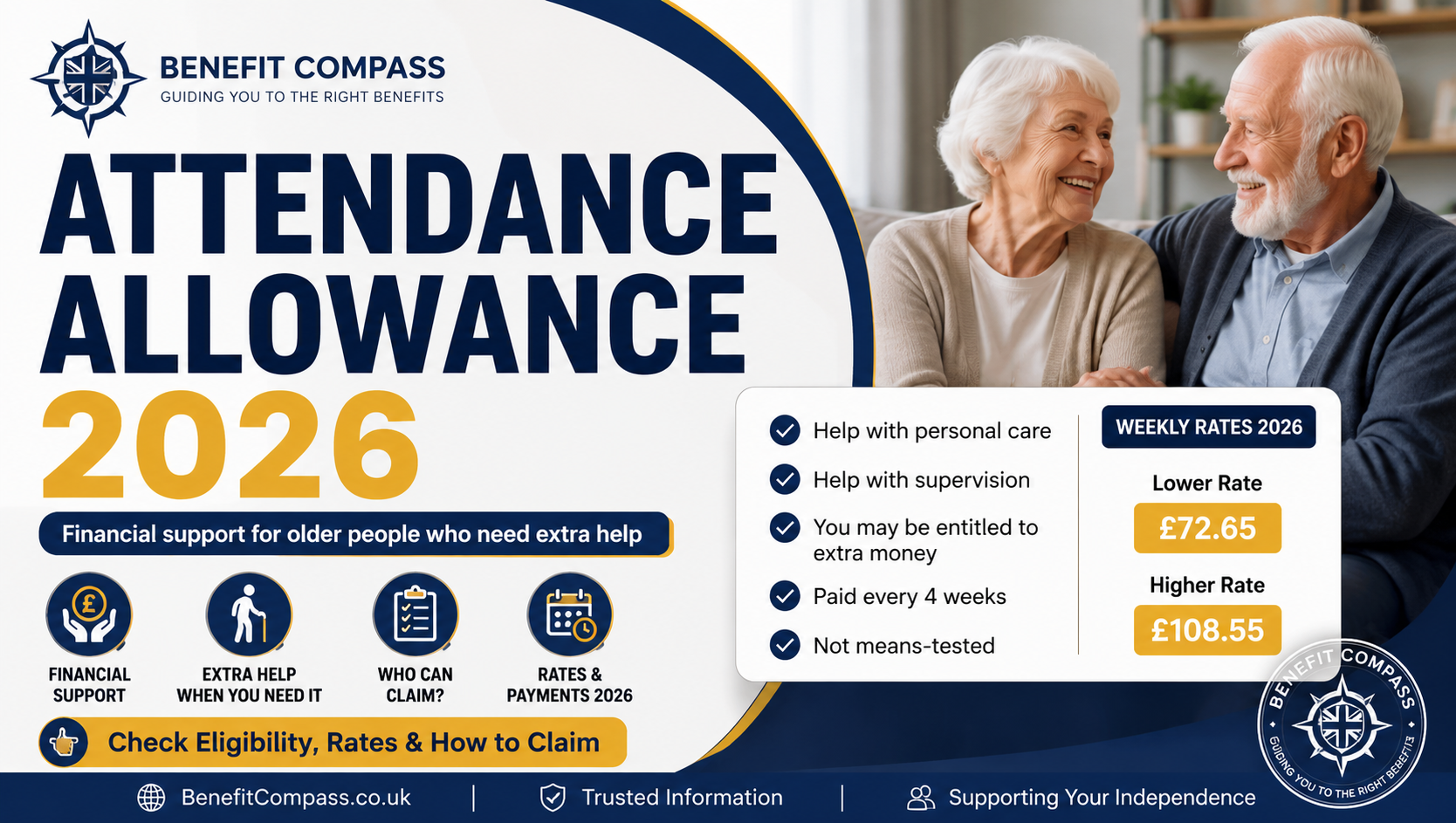
Attendance Allowance rates increased by 3.8% from April 2026, in line with the Consumer Prices Index. Attendance Allowance 2026 There are two weekly rates, and which one you’re paid depends entirely on how often you need help — not on your diagnosis Attendance Allowance 2026.
| Rate | Weekly Amount | Paid Every 4 Weeks | Annual Total |
|---|---|---|---|
| Lower rate | £76.70 | £306.80 | £3,988.40 |
| Higher rate | £114.60 | £458.40 | £5,959.20 |
For comparison, here’s how the 2026/27 rates compare with the previous year:
| Rate | 2025/26 | 2026/27 | Increase |
|---|---|---|---|
| Lower rate | £73.90 | £76.70 | £2.80/week |
| Higher rate | £110.40 | £114.60 | £4.20/week |
Payments land every four weeks rather than monthly, which means you actually receive 13 payments across the year instead of 12Attendance Allowance 2026.
Lower Rate vs Higher Rate: How It’s Decided
The rate you’re awarded comes down to a day-and-night test.
- Lower rate (£76.70/week): You need frequent help or supervision during the day, or prolonged/repeated supervision at night — but not bothAttendance Allowance 2026.
- Higher rate (£114.60/week): You need help or supervision during both the day and the night, or you’re claiming under the special rules for terminal illnessAttendance Allowance 2026.
One point that catches a lot of people out — “night supervision” doesn’t mean someone has to be physically in the room with you all night.Attendance Allowance 2026 If you need someone awake and available to keep you safe, for example because of dementia, epilepsy, or severe confusion, that can count towards a higher rate award Attendance Allowance 2026.
Read More: Universal Credit Eligibility Checker – Who Can Claim in 2026?
Who Qualifies for Attendance Allowance in 2026?
To be eligible, you need to meet every one of the following conditions Attendance Allowance 2026.
- Age: You must have reached State Pension age, currently 66. Attendance Allowance 2026 If you’re under this age and have similar care needs, you’d claim Personal Independence Payment (PIP) instead.
- Health condition: You have a physical or mental health condition, disability, sensory loss, or cognitive condition (including dementia) that affects your daily life.
- Care or supervision need: You reasonably need help with personal care, such as washing, dressing, eating, or moving around, or supervision to stay safe from falls, wandering, or seizures.
- Six-month qualifying period: You must have needed this help for at least six months before payment starts — unless you’re terminally ill, in which case this wait is removed entirely.
- Residency: You normally live in the UK and meet the standard habitual residence rules.
- No overlapping benefits: You can’t usually receive Attendance Allowance alongside PIP or Disability Living Allowance (DLA) for the same needs.
A practical example: imagine someone with early-stage Parkinson’s who struggles to get dressed and needs reminders to take medication twice a day, but manages fine overnight. That pattern of daytime-only help would typically point towards the lower rate. Now compare that to someone with advanced dementia who needs prompting during the day and someone available overnight in case they wander — that combination usually supports a higher rate claim.
How to Apply for Attendance Allowance
You apply using the AA1 claim form, a 32-page paper form that asks detailed questions about how your condition affects daily tasks.
Here’s the process from start to finish:
Step 1: Request the form. Call the Attendance Allowance helpline on 0800 731 0122, or download the form from GOV.UK.
Step 2: Fill in your personal details. This includes your National Insurance number, GP details, and any hospital or specialist involved in your care.
Step 3: Describe your care needs in detail. This is the section that decides your claim. Go beyond simply naming your condition — explain what actually happens on a bad day. Instead of writing “I have arthritis,” describe how it stops you gripping a kettle, doing up buttons, or getting up from a chair without help.
Step 4: Cover both day and night. Even if your needs feel more obvious during the day, don’t skip the night section. Missing this is one of the most common reasons people are awarded the lower rate when they may have qualified for the higher one.
Step 5: List anyone who already helps you. A family member, friend, or paid carer can add weight to your claim, though you don’t need one to qualify.
Step 6: Send the form back promptly. Your payment is backdated to the date the DWP receives your form — not the date it’s approved — so delays cost you money.
Step 7: Wait for a decision. Processing typically takes around 6 to 8 weeks, though this can vary. The DWP may contact your GP or request further information rather than arranging a face-to-face assessment.
What Attendance Allowance Can Unlock
Beyond the weekly payment itself, being awarded Attendance Allowance can trigger extra support elsewhere:
- Pension Credit: Being awarded AA can add a disability premium to your Pension Credit, sometimes worth £80 or more extra per week.
- Council Tax Reduction: Some councils offer a reduction once AA is in payment.
- Housing Benefit: If you rent, AA can increase the amount you’re entitled to.
- Carer’s Allowance for a family member: If someone provides you with 35+ hours of care a week, they may be able to claim Carer’s Allowance themselves.
If you’re already receiving Pension Credit when your AA award comes through, it’s worth contacting the Pension Service directly to have your Pension Credit recalculated. This step gets missed surprisingly often, and it can mean missing out on money you’re already entitled to.
Attendance Allowance in Scotland
If you live in Scotland, Attendance Allowance is being replaced by Pension Age Disability Payment (PADP), delivered by Social Security Scotland rather than the DWP. The payment rates are identical to Attendance Allowance, and eligibility is broadly the same, so existing claimants aren’t left worse off. New Scottish claimants generally apply for PADP directly, while existing AA awards are transferred across automatically over time.
Common Mistakes That Lead to Rejected Claims
Assuming savings or a private pension will disqualify you. They won’t — Attendance Allowance has never been means-tested.
Underselling how bad the worst days are. Many people describe their condition on an average day, when the form is really asking about your worst, most typical bad days.
Leaving the night section blank. If you have any night-time needs at all, even occasional ones, include them.
Forgetting supervision, not just physical help. Needing someone nearby to prevent falls or confusion counts just as much as needing help washing or dressing.
Applying too late. Since payment is backdated only to the date DWP receives your form, waiting even a few extra weeks to apply is money you can’t get back.
Final Thoughts
Attendance Allowance remains one of the most underclaimed benefits in the UK, and the 2026/27 increase to £76.70 and £114.60 a week makes it more valuable than ever for pensioners managing a health condition or disability. If daily tasks have become harder over the past six months, it’s worth applying rather than assuming you won’t qualify — the eligibility rules are based on your care needs alone, not your bank balance. Filling in the AA1 form honestly and in detail, covering both day and night needs, gives you the best chance of getting the rate you’re actually entitled to.
FAQ’s
How much is Attendance Allowance in 2026?
Attendance Allowance pays £76.70 a week at the lower rate or £114.60 a week at the higher rate, depending on your day and night care needs.
Is Attendance Allowance taxable?
No. It’s completely tax-free and doesn’t count as income for tax purposes or for most means-tested benefits.
Does Attendance Allowance affect my State Pension?
No. Your State Pension is unaffected, and Attendance Allowance is paid entirely separately.
Can I claim Attendance Allowance if I have savings?
Yes. Attendance Allowance is not means-tested, so your savings, investments, and other income have no bearing on your claim.
Do I need a diagnosed condition to qualify?
No specific diagnosis is required. What matters is how your condition affects your ability to care for yourself or stay safe, not the medical label attached to it.
What’s the difference between Attendance Allowance and PIP?
Attendance Allowance is for people over State Pension age, while PIP is for people under that age with similar care or mobility needs. Attendance Allowance has no mobility component; it’s based purely on care and supervision needs.
How long does an Attendance Allowance claim take to process?
Most claims take around 6 to 8 weeks, though this can vary depending on how much additional information the DWP needs to request.
Will claiming Attendance Allowance affect my Pension Credit?
Being awarded Attendance Allowance can actually increase your Pension Credit by adding a disability element, rather than reducing it.
Can I still claim if I live alone with no carer?
Yes. You don’t need to already be receiving help. The test is whether you reasonably need it, regardless of whether anyone is currently providing it.
What happens if I move into a care home?
If your care home is funded by the local council, Attendance Allowance usually stops after 28 days. If you fund your own care privately, your payments continue as normal.