Disability Living Allowance (DLA) 2026 Disability Living Allowance is one of the most misunderstood benefits in the UK system, and it’s easy to see why. It was largely phased out for adults years ago in favour of PIP, yet it’s still very much active for children, and a shrinking number of adults are quietly still receiving it under rules nobody ever properly explained to them.
If you’re trying to work out whether DLA is something you can still apply for, how much it actually pays in 2026/27, or why your neighbour’s child gets DLA while you were told to look at something else entirely, this guide walks through all of it in plain English — from eligibility and rates through to how the DWP makes its decisions and what to do if one doesn’t go your way.
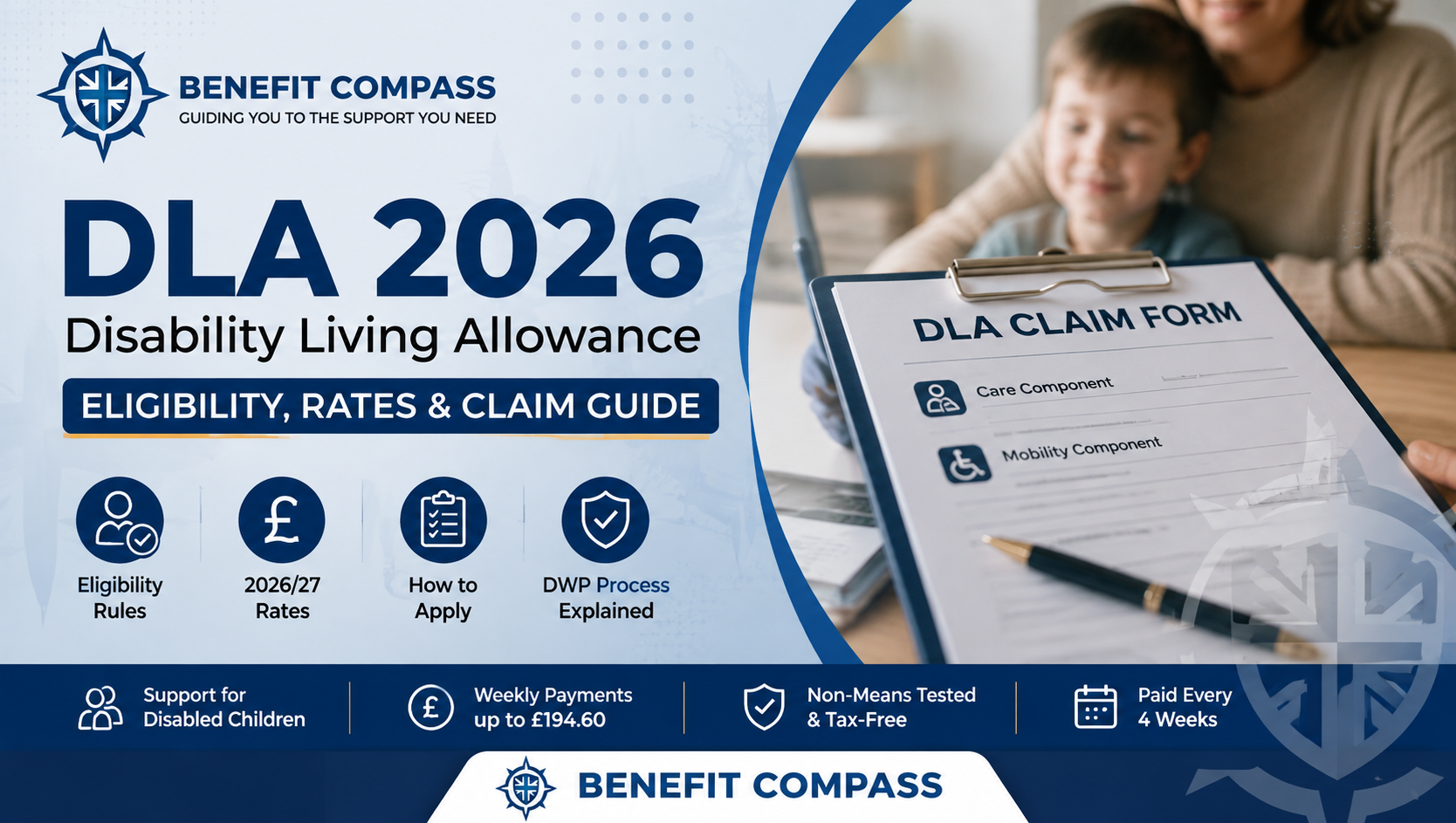
Quick answer: Disability Living Allowance (DLA) is a tax-free, non-means-tested benefit that helps with the extra costs of a disability. (Disability Living Allowance (DLA) 2026) For 2026/27, weekly payments range from £30.30 to £194.60, made up of a care component (£30.30, £76.70 or £114.60) and a mobility component (£30.30 or £80.00). New claims are only open to children under 16 — adults now apply for Personal Independence Payment (PIP) instead, unless they were already receiving DLA before the switchover.
Visit Now: Mauricette-calculette.fr
What This Guide Covers
- Why DLA still exists in 2026, and who it’s actually for
- The key terms used throughout DLA decisions and DWP letters
- Why getting this right matters beyond the payment itself
- Common misconceptions that stop people applying who shouldn’t rule themselves out
- Full eligibility rules and the current care and mobility rates
- How the DWP assesses a claim, and how to avoid the mistakes that most often cost families money
- The step-by-step claims process, what happens after you submit, and how to challenge a decision
Background: Why DLA Still Exists in 2026
Disability Living Allowance was introduced back in 1992 as the main disability benefit for both children and working-age adults. (Disability Living Allowance (DLA) 2026) For over two decades, (Disability Living Allowance (DLA) 2026) it was the default option for anyone needing extra financial support because of a disability or long-term health condition.
That changed between 2013 and 2019, when the government gradually rolled out Personal Independence Payment to replace DLA for everyone aged 16 to State Pension age. (Disability Living Allowance (DLA) 2026) Existing adult claimants were reassessed one by one and moved across, based on a points-based system rather than DLA’s older approach.
By 2026, that transition is largely finished, but not complete. Two groups still rely on DLA:
- Children under 16, who have never been eligible for PIP and continue to apply for DLA as normal
- A small and shrinking number of adults who were already receiving DLA and haven’t yet been invited by the DWP to move across to PIP
If you fall into either group, DLA rates are still reviewed and uprated every April, in line with the rest of the benefits system.
Read More: 25 UK Government Grants You Can Claim in 2026
Key Terms You Need to Understand First
Before getting into eligibility and rates, it helps to be clear on a few terms that come up constantly in DLA paperwork and DWP letters.
Care Component (Disability Living Allowance (DLA) 2026)
The part of DLA that covers help with daily living — things like getting dressed, (Disability Living Allowance (DLA) 2026) eating, taking medication, or needing supervision to stay safe. It’s paid at one of three rates: lowest, middle, or highest, depending on how much help is needed and how often.
Mobility Component (Disability Living Allowance (DLA) 2026)
Covers the extra cost of getting around, (Disability Living Allowance (DLA) 2026) whether that’s difficulty walking or needing guidance and supervision outdoors. It’s paid at one of two rates: lower or higher.
Transitional Protection
The term used for adults who were receiving DLA before PIP existed and haven’t yet been reassessed. (Disability Living Allowance (DLA) 2026) Their award simply continues at the current rate until the DWP contacts them to start a PIP claim.
Qualifying Period
DLA generally requires that a condition has already affected the person for at least three months, and is expected to continue for at least six months more. (Disability Living Allowance (DLA) 2026) This is sometimes called the “backward and forward” test, and it doesn’t apply where a child qualifies under the Special Rules for terminal illness.
Why This Matters (Disability Living Allowance (DLA) 2026)
Getting DLA wrong — either by not claiming when you’re entitled to, or misunderstanding which benefit applies to your situation — can mean missing out on far more than the DLA payment itself.
DLA acts as a gateway benefit. A child’s award, particularly at the middle or highest care rate, can unlock:
- Carer’s Allowance for a parent providing 35+ hours of care a week
- The Disabled Child Element within Universal Credit
- Blue Badge eligibility and access to the Motability scheme
- Additional support through school and local council services
Missing an application, or assuming ineligibility without checking, can mean losing hundreds of pounds a month in related support — not just the DLA payment on its own.
Common Misconceptions About DLA
There’s a lot of outdated or half-correct information circulating about this benefit, so it’s worth clearing a few things up early.
| Misconception | The Reality |
|---|---|
| “DLA has been completely replaced by PIP.” | Only true for adults. (Disability Living Allowance (DLA) 2026) DLA remains the correct benefit for children under 16. |
| “You can apply for DLA as an adult if you’ve never claimed before” | New adult claims aren’t accepted under any circumstances. Adults apply for PIP instead. |
| “DLA is means-tested, so my savings will affect it” | DLA isn’t means-tested at all. Income and savings make no difference to the amount paid. |
| “My child’s condition isn’t severe enough to qualify” | There’s no severity threshold or approved list of conditions — awards are based on day-to-day need. |
| “Everyone on DLA will eventually be moved to PIP automatically” | Adults are only moved when the DWP formally invites them — it doesn’t happen without notice. |
A Practical Example
To make this less abstract, take Sarah, a mother whose 8-year-old son has autism and epilepsy. (Disability Living Allowance (DLA) 2026) She assumed DLA wasn’t worth applying for because her son “isn’t as severely affected as some children” she’d read about online.
In reality, DLA doesn’t require a specific diagnosis or a severity threshold — it’s based on how much extra care and supervision a child needs compared with a child of the same age without a disability. (Disability Living Allowance (DLA) 2026) After applying and describing her son’s actual day-to-day needs, including supervision around seizures and support with daily routines, he was awarded the middle rate care component. That decision, in turn, opened up Carer’s Allowance for Sarah and a disabled child addition on their Universal Credit.
This is a common pattern: people rule themselves out based on assumptions about severity, (Disability Living Allowance (DLA) 2026) rather than checking what DLA is actually assessed against — which is exactly where the eligibility rules become worth looking at in detail.
DLA Eligibility Rules for 2026/27
Eligibility depends entirely on who’s applying — a child under 16, or an adult already receiving DLA under transitional protection. (Disability Living Allowance (DLA) 2026) The criteria for each group are different enough to look at separately.
Eligibility for Children Under 16
To qualify, a child must meet all of the following:
- They’re under 16. At 16, they move onto PIP instead, and the DWP contacts the family ahead of time to start that process.
- They usually live in England, Wales, or Northern Ireland. Scotland uses Child Disability Payment (CDP) instead, run by Social Security Scotland.
- They need substantially more looking after than a child of the same age without a disability, or they have significant difficulty walking, or both.
- The condition has already lasted at least three months, and is expected to last at least six months more — unless the child is terminally ill, in which case Special Rules apply and claims are fast-tracked.
There’s no approved list of qualifying conditions. (Disability Living Allowance (DLA) 2026) DLA for children is based on the practical impact of a condition, not the diagnosis itself. (Disability Living Allowance (DLA) 2026) Two children with an identical diagnosis can receive very different awards, because one needs far more day-to-day support than the other.
Read More: Free School Meals Eligibility – Complete Guide for Parents
Eligibility for Adults Already on DLA
If you’re an adult already receiving DLA, you don’t need to reapply or requalify each year. (Disability Living Allowance (DLA) 2026) Your award simply continues at the current rate until one of the following happens:
- The DWP writes to you inviting you to claim PIP (known as a “reassessment”)
- Your circumstances change significantly and you report it
- You reach State Pension age, at which point special rules apply and you’re no longer moved onto PIP
Important: you cannot start a brand-new DLA claim as an adult in 2026, even if you were previously entitled to it years ago and let the claim lapse. Once a DLA award ends for an adult, the only route back into disability benefits is through PIP (Disability Living Allowance (DLA) 2026).
DLA Rates 2026/27 – Full Breakdown
DLA rates increased from 6 April 2026, in line with the annual DWP uprating. (Disability Living Allowance (DLA) 2026) Here’s exactly what’s paid now.
Care Component
| Rate | Weekly Amount | Who It’s For |
|---|---|---|
| Lowest | £30.30 | Needs help with some daily activities, or can’t prepare a cooked main meal |
| Middle | £76.70 | Needs frequent help or supervision during the day, at night, or both |
| Highest | £114.60 | Needs help or supervision throughout both day and night, or is terminally ill |
Mobility Component
| Rate | Weekly Amount | Who It’s For |
|---|---|---|
| Lower | £30.30 | Can walk but needs guidance or supervision outdoors, from age 5 |
| Higher | £80.00 | Cannot walk, or walking is very difficult, from age 3 |
Combined Awards
A child, or a transitionally protected adult, can receive both components at once (Disability Living Allowance (DLA) 2026). The maximum possible combined award is £194.60 a week — highest rate care plus higher rate mobility. DLA is paid every four weeks, not weekly or monthly, which catches some families out when they’re budgeting around the wrong cycle.
Example: Priya’s daughter has cerebral palsy affecting her mobility and needs supervision throughout the night because of seizure risk. She was awarded highest rate care (£114.60) and higher rate mobility (£80.00), giving a combined weekly payment of £194.60, paid every four weeks into her mother’s account.
DLA vs PIP: What’s the Actual Difference?
Because DLA and PIP cover similar ground, it’s tempting to assume they work the same way (Disability Living Allowance (DLA) 2026). They don’t.
| Feature | DLA | PIP |
|---|---|---|
| Who can claim | Children under 16; some existing adult claimants | Adults aged 16 to State Pension age |
| Assessment method | Paper-based, no interview | Points-based, usually with a consultation |
| Number of rates | 3 care rates, 2 mobility rates | 2 daily living rates, 2 mobility rates |
| New claims open | Yes, for children | Yes, for adults |
| Review frequency | Varies, often 1–5 years | Typically every 2–5 years |
The rate structures don’t map neatly onto each other, which is one reason families often notice a change in payment when a young person moves from DLA to PIP at 16 — sometimes higher, sometimes lower, depending entirely on how needs are assessed under PIP’s criteria rather than DLA’s.
How the DWP Assesses a DLA Claim
Unlike PIP, which uses a points-based assessment with a face-to-face or telephone consultation, (Disability Living Allowance (DLA) 2026) DLA for children is assessed entirely on paperwork — there’s no assessment interview.
The process typically works like this:
- You complete the DLA1 Child form, either on paper or by requesting one through the DLA helpline.
- You describe your child’s needs in detail, comparing them to a child of the same age without a disability. (Disability Living Allowance (DLA) 2026) This section decides the outcome, so vague answers tend to lead to lower awards or refusals.
- You provide supporting evidence — letters from a GP, consultant, school SENCO, health visitor, or any professional involved in your child’s care.
- A DWP decision maker reviews the form and evidence, without meeting your child, and decides whether to award DLA and at what rate.
- You receive a decision letter, usually within a few weeks, confirming the award, the rate, and the review date.
Read More: Jobseeker’s Allowance (JSA) 2026 – Eligibility, Rates & How to Apply
Expert Tip: How You Describe Needs Matters More Than the Diagnosis
The single biggest reason DLA claims are turned down or under-awarded isn’t a lack of medical evidence — it’s forms that describe a condition rather than its day-to-day impact. Writing “my son has ADHD” tells the decision maker very little. (Disability Living Allowance (DLA) 2026) Writing “I have to physically guide my son through every step of getting dressed each morning, or he becomes distressed and refuses to continue” gives them something they can actually assess against the criteria.
A useful approach is to think through a typical day, hour by hour, and note down every point where your child needs more help, supervision, or reassurance than another child their age would.
Common Mistakes When Applying for DLA
| Mistake | Why It Matters |
|---|---|
| Describing the diagnosis instead of the daily impact | Decision makers assess need, not the name of the condition |
| Leaving sections blank because “it doesn’t apply” | Blank sections are often read as “no need,” even when that’s not accurate |
| Not comparing your child to a child of the same age | This comparison is central to how DLA is assessed |
| Submitting the form without supporting evidence | Evidence from professionals significantly strengthens a claim |
| Assuming a short-term condition won’t qualify | If it’s expected to last six months or more from the date of claim, it can still be considered |
| Waiting for things to “get worse” before applying | You can apply based on current needs — there’s no requirement to wait |
Best Practices Before You Submit
A few habits consistently lead to stronger, more accurate DLA outcomes:
- Keep a diary for a week or two before applying. Note every instance of extra help, supervision, or difficulty, even small ones. Patterns that feel routine to you are often exactly what the DWP needs to see written down.
- Ask professionals for supporting letters early. GPs and specialists can take weeks to respond, so requesting evidence before you start the form avoids delays.
- Keep copies of everything before sending it. Original evidence sometimes needs to go in the post, and having your own copy protects you if anything goes missing.
- Use real examples, not general statements. “He needed reminding three times to eat breakfast this morning” is stronger evidence than “he struggles with routines.”
A Real-Life Scenario Worth Knowing
Consider Michael, whose 6-year-old daughter has Type 1 diabetes. His first instinct was that diabetes “isn’t really a disability” and he almost didn’t apply. But her condition means constant blood sugar monitoring, overnight checks to prevent dangerous drops, and close supervision around food and activity that a child her age wouldn’t otherwise need. Once he described that reality on the form rather than just naming the condition, she was awarded the middle rate care component. It’s a reminder that DLA isn’t reserved for conditions that look obviously severe from the outside — it’s about the actual supervision and support involved day to day.
If a claim is refused, or awarded at a lower rate than expected, that isn’t the final word — there’s a formal process for challenging it, covered below, along with time limits worth knowing before you submit.
How to Claim DLA Step by Step
Once you’ve gathered your evidence and thought through your child’s day-to-day needs, the claim itself follows a fairly straightforward path.
- Request the DLA1 Child form. Call the Disability Living Allowance helpline on 0800 121 4600, or download it from gov.uk if you’d rather fill it in digitally and print it.
- Complete every section fully, even ones that feel repetitive. The form deliberately asks about the same areas in different ways to build a fuller picture.
- Attach supporting evidence — letters, reports, or assessments from anyone involved in your child’s care or education.
- Send the form back within 6 weeks of requesting it, or your claim date may be affected. If you need longer, you can call and ask for an extension.
- Wait for a decision, which typically takes between 6 and 12 weeks, though it can take longer during busy periods.
- Receive your award letter, confirming the rate, components awarded, and the date of your next review.
Your claim date is usually backdated to the date you first requested the form, not the date you posted it back — so requesting the form promptly matters even if you need time to complete it properly.
Read More: Disability Living Allowance (DLA) 2026 – Eligibility, Rates & Payment Guide
What Happens After You Submit (Disability Living Allowance (DLA) 2026)
Once your form arrives at the DWP, a decision maker reviews it alongside any evidence you’ve sent (Disability Living Allowance (DLA) 2026). They won’t usually contact you unless something is unclear or missing, so don’t take silence as a bad sign.
If more information is needed, you may be asked to:
- Provide additional evidence from a specific professional
- Clarify an answer that seemed inconsistent with the rest of the form
- Confirm details about your child’s living situation
Once a decision is made, you’ll get a letter explaining the outcome, the rate awarded (if any), and the date of the next review. (Disability Living Allowance (DLA) 2026) DLA awards for children are rarely permanent, since needs can change significantly as a child grows.
If You Disagree With the Decision
If DLA is refused, or awarded at a lower rate than you expected, you have the right to challenge it.
- Mandatory Reconsideration — you must request this within one month of the decision letter. A different decision maker looks at your case again, often alongside any new evidence you provide.
- Appeal to the Tribunal — if the Mandatory Reconsideration doesn’t change the outcome, you can appeal to the Social Security and Child Support Tribunal, an independent body separate from the DWP.
A significant number of decisions are overturned at the mandatory reconsideration or appeal stage, often because the original form didn’t fully capture the day-to-day reality of the child’s needs. (Disability Living Allowance (DLA) 2026) Adding more specific, concrete examples at this stage — rather than repeating what was already said — tends to make the biggest difference.
Advanced Tips Most Guides Miss
A few details rarely get covered but genuinely change outcomes:
- Reviews aren’t just a formality. If your child’s needs have increased since the original award, a review is the moment to report that clearly — awards can go up as well as down.
- You can request an early review yourself. You don’t have to wait for the DWP’s scheduled review date if your child’s needs change significantly in the meantime.
- Terminal illness claims use the Special Rules. These allow highest rate care to be awarded automatically, without the usual qualifying period, and claims are fast-tracked.
- A DLA award can unlock backdated payments elsewhere. If it later triggers Carer’s Allowance or the Universal Credit disabled child element, those can sometimes be backdated too, depending on when you report the change.
- Turning 16 doesn’t mean an automatic gap in payments. The DWP typically starts the PIP process for a young person before their 16th birthday, so DLA usually continues until that PIP claim is decided.
Frequently Overlooked Information
| Overlooked Detail | Why It Matters |
|---|---|
| DLA is paid every 4 weeks, not weekly or monthly | Budgeting around the wrong payment cycle can cause confusion |
| A change of address or school doesn’t affect eligibility | But you should still report it to keep DWP records accurate |
| DLA doesn’t count as income for most benefits | It’s ignored for Universal Credit, Tax Credits, and Housing Benefit calculations |
| Help completing the form is available for free | Citizens Advice and local welfare rights services offer this at no cost |
| A refused claim can be reapplied for later | If circumstances change, a fresh claim can be made — you’re not permanently barred |
Key Takeaways
- Decisions can be challenged through Mandatory Reconsideration and, if needed, a Tribunal appeal.
- DLA is now mainly a benefit for children under 16, with adults only remaining on it under transitional protection.
- It’s tax-free, not means-tested, and paid regardless of household income or savings.
- Awards range from £30.30 to £194.60 a week, depending on the care and mobility components awarded.
- The assessment is paperwork-based, so how you describe daily needs matters more than the diagnosis itself.
Read More: Employment and Support Allowance (ESA) 2026 – Eligibility, Rates & Claim Guide
Final Thoughts
(Disability Living Allowance (DLA) 2026) Disability Living Allowance can feel like a confusing benefit to navigate in 2026, mainly because it now serves a much narrower group than it used to. But for the families who still rely on it — parents of disabled children, and adults under transitional protection — understanding exactly how it works can make a real difference, both to the payment itself and to the wider support it unlocks.
(Disability Living Allowance (DLA) 2026)Getting the application right the first time comes down to one thing more than any other: describing your child’s actual daily needs clearly and specifically, rather than letting a diagnosis speak for itself. Whether you’re applying for the first time, preparing for a review, or challenging a decision, that’s the detail that consistently shapes the outcome of a Disability Living Allowance claim.
FAQ’s
Is Disability Living Allowance still available in 2026?
Yes, Disability Living Allowance (DLA) 2026, but only for children under 16 and for adults who were already receiving DLA before PIP replaced it. New adult claims aren’t accepted.
How much is Disability Living Allowance in 2026/27?
Between £30.30 and £194.60 a week (Disability Living Allowance (DLA) 2026), depending on which care and mobility rates are awarded.
Can adults still apply for DLA?
No. (Disability Living Allowance (DLA) 2026) Adults now apply for Personal Independence Payment (PIP) instead. Only existing DLA claimants continue receiving it under transitional protection.
Does DLA affect other benefits like Universal Credit?
No, (Disability Living Allowance (DLA) 2026) isn’t counted as income and doesn’t reduce Universal Credit, Tax Credits, or Housing Benefit. In fact, it can unlock additional elements within those benefits.
How long does a Disability Living Allowance (DLA) 2026 take to process?
Typically 6 to 12 weeks from when the completed form is received, though it can take longer during busier periods.
What happens to the Disability Living Allowance 2026 when a child turns 16?
The DWP usually starts the process of moving them onto PIP before their 16th birthday, and DLA continues until that PIP claim is decided.
Can DLA be backdated?
Your claim is generally backdated to the date you first contacted the DWP to request the form, not the date you returned it (Disability Living Allowance (DLA) 2026).
What if my child’s DLA claim is refused?
You can request a Mandatory Reconsideration within one month, and appeal to the Social Security and Child Support Tribunal if the decision doesn’t change.
Does DLA require a medical assessment?
No. (Disability Living Allowance (DLA) 2026) Unlike PIP, DLA for children is assessed entirely through the application form and supporting evidence, without a face-to-face or telephone assessment.
Is DLA available in Scotland?
Not for children. Scotland uses Child Disability Payment (CDP) instead, delivered by Social Security Scotland, using similar rates and criteria.