How much Universal Credit rates 2026 will you actually get? It is the question behind millions of UK searches every year — and in 2026 the answer has changed more than usual. The standard allowance has risen, the two-child limit has been abolished, and the LCWRA disability element has split into two tiers. If you are relying on last year’s figures, or on a calculator that has not been updated, you could be underestimating your entitlement by hundreds of pounds a month.
See the official Universal Credit rates 2026 guidance on GOV.UK for full details.
This guide gives you the verified Universal Credit rates 2026 for 2026/27 — every element, checked against the DWP’s official rates and gov.uk — plus worked examples showing what real households receive, and a clear step-by-step walkthrough of how to apply.
Key takeaways:
- The 2026/27 standard allowance runs from £338.58 to £666.97 a month, depending on your age and whether you claim as a couple.
- The two-child limit is gone: the child element of £303.94 a month is now paid for every eligible child.
- The LCWRA element has split into two tiers — £217.26 or £429.80 a month — depending on severity and when you reported your condition.
- If you work, you keep the first £427 or £710 of earnings (work allowance), then lose 55p per £1 above that.
- You apply online, your first payment arrives after about 5 weeks, and you can request an advance to bridge the gap.
Universal Credit rates 2026: What is Universal Credit rates 2026?
Universal Credit rates 2026 (Universal Credit rates 2026) is the UK’s main working-age benefit, paid monthly by the DWP. It has replaced six older “legacy” benefits — including Income Support, income-based Jobseeker’s Allowance, income-related Employment and Support Allowance, Housing Benefit, Child Tax Credit and Working Tax Credit — rolling them into a single payment that adjusts as your circumstances change.
Your Universal Credit rates 2026 payment is built from a standard allowance plus extra elements for children, housing costs, disability or health conditions, and caring responsibilities. Earnings reduce it gradually rather than stopping it, which is why over a million working people also receive Universal Credit rates 2026. If you are unsure whether you qualify at all, our Universal Credit rates 2026 eligibility checker walks through the rules.
Universal Credit rates 2026: the standard allowance
Everyone who gets Universal Credit rates 2026 receives the standard allowance. The 2026/27 monthly amounts, in force from April 2026, are:
| Your situation | Monthly standard allowance 2026/27 |
|---|---|
| Single, under 25 | £338.58 |
| Single, 25 or over | £424.90 |
| Couple, both under 25 | £528.34 |
| Couple, one or both 25 or over | £666.97 |
This year’s rise — around 6.2%, above inflation — was legislated by the Universal Credit rates 2026 Act 2025, and above-inflation rises are set to continue through 2029/30. On top of the standard allowance, you may qualify for the elements below.
Universal Credit rates 2026: Child element 2026: the two-child limit is gone
One of the biggest 2026 changes: the two-child limit has been abolished. The child element is now paid for every child who lives with you:
| Child element | Monthly amount 2026/27 |
|---|---|
| Each child living with you | £303.94 |
| Extra if your first child was born before 6 April 2017 | £47.94 (total £351.88 for that child) |
| Disabled child, lower rate | £164.79 |
| Disabled child, higher rate | £514.71 |
The element is paid until 31 August after the child’s 16th birthday (or 19th if they stay in approved education or training). Note that Child Benefit is entirely separate — you can and should claim it alongside UC.
Important caveat: around 50,000 larger families will see no extra money from the third-child element because the frozen benefit cap (see below) swallows the increase. If your payment has not risen and you have three or more children, the cap is the first thing to check.
Health, disability and carer elements
If you or your partner have a health condition or disability, or you care for someone who does, these monthly elements may apply:
| Element | Monthly amount 2026/27 |
|---|---|
| LCW (limited capability for work) | £158.76 |
| LCWRA — severe / unlikely to change, terminal illness, or condition reported before 6 April 2026 | £429.80 |
| LCWRA — new claims, less severe or may improve | £217.26 |
| Carer element | £209.34 |
The LCWRA two-tier split is new from April 2026 and is the most confusing change this year. In plain terms: if you reported your health condition before 6 April 2026, or your condition is severe and unlikely to change, or you are nearing the end of life, you get the higher £429.80. Newer claims assessed as less severe get £217.26. If you are unsure which applies to you, check your UC journal or ask your work coach — and report any missing element via your journal.
The carer element (£209.34) is for people providing 35+ hours of care a week to someone on a qualifying disability benefit. Note you cannot receive the carer element and LCWRA at the same time, and Carer’s Allowance itself is deducted pound-for-pound from UC.
Working on Universal Credit rates 2026: the work allowance and taper
UC is designed so that work pays. If you are responsible for a child or have LCW/LCWRA, you get a work allowance — an amount you can earn before your UC starts to reduce:
| Your situation | Monthly work allowance 2026/27 |
|---|---|
| You get help with housing costs through UC | £427 |
| You do not get housing help through UC | £710 |
Earnings above the allowance reduce your UC by 55p for every £1 (the taper rate). A quick example: you are single, 30, renting is not covered by UC, and you earn £900 a month. Your work allowance is £710, so £190 of earnings count. The taper takes 55% of £190 = £104.50 off your UC. Your payment is £424.90 − £104.50 = £320.40, on top of your £900 wages — £1,220.40 in total.
Worked examples: what four households actually get
Figures exclude the housing element, which depends on your local housing allowance — see our housing help guide for how that works.
1. Aisha, 28, single, no children, not working.
Standard allowance: £424.90/month. Total: £424.90 plus any housing element.
2. Daniel, 34, single parent of two (ages 4 and 7), not working.
Standard allowance £424.90 + child element 2 × £303.94 = £607.88. Total: £1,032.78/month plus housing.
3. Priya and Tom, both 31, three children (ages 2, 5 and 9).
Standard allowance £666.97 + child element 3 × £303.94 = £911.82. Total: £1,578.79/month plus housing — but watch the benefit cap below, which can bite larger families once housing is added.
4. Marcus, 30, single, working and earning £900/month, no housing help.
Standard allowance £424.90 − taper (£104.50) = £320.40/month UC, plus £900 wages.
The benefit cap: the ceiling that can swallow your increase
The benefit cap limits the total most working-age households can receive. It is frozen for 2026/27:
| Household | Outside London | Greater London |
|---|---|---|
| Couple, or single parent with children | £1,835/month | £2,110.25/month |
| Single adult, no children | £1,229.42/month | £1,413.92/month |
There are exemptions — for example, if you earn above a set threshold, receive certain disability benefits, or are within a 9-month grace period after leaving work. If your UC seems lower than the tables suggest, the cap is a prime suspect. The benefit cap helpline is 0800 169 0145.
How to apply for Universal Credit rates 2026: step by step
- Check you are better off first. Claiming UC permanently ends most legacy benefits, so run a benefits calculator or speak to Citizens Advice’s Help to Claim service before you start.
- Apply online at gov.uk (or by phone on 0800 328 5644 if you cannot apply online). Create an account and complete the claim within 28 days, or you will have to start again. Your claim starts from the date you submit.
- Claiming as a couple? Both partners must create accounts and link them — one person cannot complete a joint claim alone.
- Have your documents ready: bank or building society details, email address, ID (driving licence, passport, debit/credit card, payslip or P60), National Insurance number, housing costs, earnings, savings and investment details, and childcare costs if relevant.
- Complete your to-do list. Your online account will list tasks — answer them promptly, because delays hold up your first payment.
- Attend any appointment. You may be asked to verify your identity at a jobcentre or by phone.
- Accept your claimant commitment. You must agree to this in your account before your first payment — otherwise the claim stops. For a fuller walkthrough, see our step-by-step UC application guide.
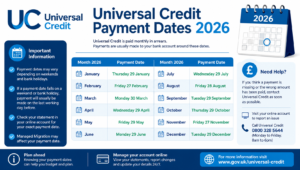
- Wait for your first payment — about 5 weeks. Your assessment period is one calendar month from your claim date, and payment follows 7 days later, then monthly on the same date. (In Scotland you can opt for twice-monthly payments.) Track the dates with our UC payment dates 2026 calendar.
- Stay in touch via your journal. Your case manager and work coach contact you through journal messages — you will get a text or email alert. Never share bank details in the journal or by phone: the DWP warns about scams doing exactly this.
One thing UC does not cover is council tax — if you need help with that, check Council Tax Reduction separately with your local council.
Apply directly on GOV.UK.
Need money before your first payment? Advances explained
The five-week wait catches many new claimants out. Options if you are struggling:
- New-claim advance: borrow up to 100% of your estimated first payment. Request it through your journal, your work coach, or the helpline — but your identity must be verified first, and decisions are usually same-day. It is a loan: repayments come out of future UC over 24 months (for example, a £344 advance repays at about £14.33 a month), and you can ask to delay repayments by 3 months if you are struggling.
- Budgeting Advance: for one-off costs like furniture, a cooker, clothes or a rent deposit (not everyday bills). From £100 up to £348 (single), £464 (couple) or £812 (with children). You generally need 6 months on UC and low recent earnings, and it repays over 24 months.
- Hardship payment: if you have been sanctioned, you may get help with food, heating and hygiene — repaid later from your UC.
- Total deductions from your UC are now capped at 15% of your standard allowance (down from 25%), which limits how much advances and overpayments can take each month.
Common problems — and how to avoid them
These come up again and again in claimant forums:
- Savings shock. Over £16,000 in savings or investments means no UC at all. Between £6,001 and £16,000, every £250 (or part of £250) above £6,000 is treated as £4.35/month of “tariff income”. Note the trap: £6,001 counts, not £6,250.
- Wages counted as capital. Money sitting in your account on the last day of your assessment period can count as savings — even if it is wages paid in arrears that you need for living costs.
- Unreported changes. Moving house, a partner moving in, or a change in childcare costs must be reported via your journal promptly — overpayments get clawed back.
- Childcare evidence. You pay childcare upfront and claim back 85% (up to £1,071.09/month for one child, £1,836.16 for two or more). Keep invoices: you will usually need to upload them monthly.
- Missing elements. If the two-child-limit removal or an LCWRA tier has not appeared in your award, report it via your journal rather than waiting.
Frequently asked questions
How much Universal Credit rates 2026 will I get?
It depends on your standard allowance plus any elements for children, housing, disability or caring — minus the taper on earnings above your work allowance. Use the tables and worked examples above for a realistic estimate, then confirm with a benefits calculator (entitledto or Turn2us) before claiming.
When will I get my first Universal Credit rates 2026 payment?
About 5 weeks after you claim: one calendar month as your assessment period, then payment 7 days later, and monthly after that on the same date. If you cannot wait, ask about a new-claim advance through your journal.
Can I get Universal Credit rates 2026 if I have savings?
Yes, up to £16,000. Savings of £6,000 or less are ignored; above that, tariff income of £4.35/month per £250 applies until £16,000, at which point you cannot claim.
What is the new LCWRA two-tier rate?
From April 2026 there are two LCWRA rates: £429.80/month if your condition is severe and unlikely to change, you are terminally ill, or you reported it before 6 April 2026 — and £217.26/month for newer claims assessed as less severe. The LCW rate is £158.76.
Will I get more money now the two-child limit is gone?
Most families with three or more children will: the £303.94/month child element now applies per child. But the frozen benefit cap means around 50,000 families see no net gain — check whether the cap applies to you, and report any missing child element via your journal.
Will working reduce my Universal Credit?
Only gradually. You keep the first £427 or £710 of monthly earnings (depending on housing help), then lose 55p per £1 above that. Many people are significantly better off working — see the worked example above.
What if I move house or my circumstances change?
Report it in your UC journal straight away — address changes, new children, changes in rent, earnings or health. Late reporting can mean overpayments you must repay. If a change leaves you short, a change-of-circumstances advance (usually repaid over 6 months) may help.
Do I need to apply for Child Benefit separately?
Yes — Child Benefit is a separate benefit and is not included in UC. Claim it alongside UC to make sure you are getting everything you are entitled to.
Universal Credit in 2026 is more generous than it was — but only if every element you qualify for is actually in your award. Work through the tables above, check the 2026 rule changes that apply to you, and do not be afraid to query your journal if something looks missing. The money is there to be claimed.