Council Tax Reduction If your council tax bill feels heavier than your income can handle, you’re not alone — and you might not have to pay the full amount. Council Tax Reduction is one of the most underused forms of support in the UK, partly because people assume it only applies to those on benefits, and partly because every council runs its own version of the scheme.
This guide walks you through who qualifies, how much you could save, and exactly how to apply — step by step.
Visit Now: https://wishlio.site/
What Is Council Tax Reduction?
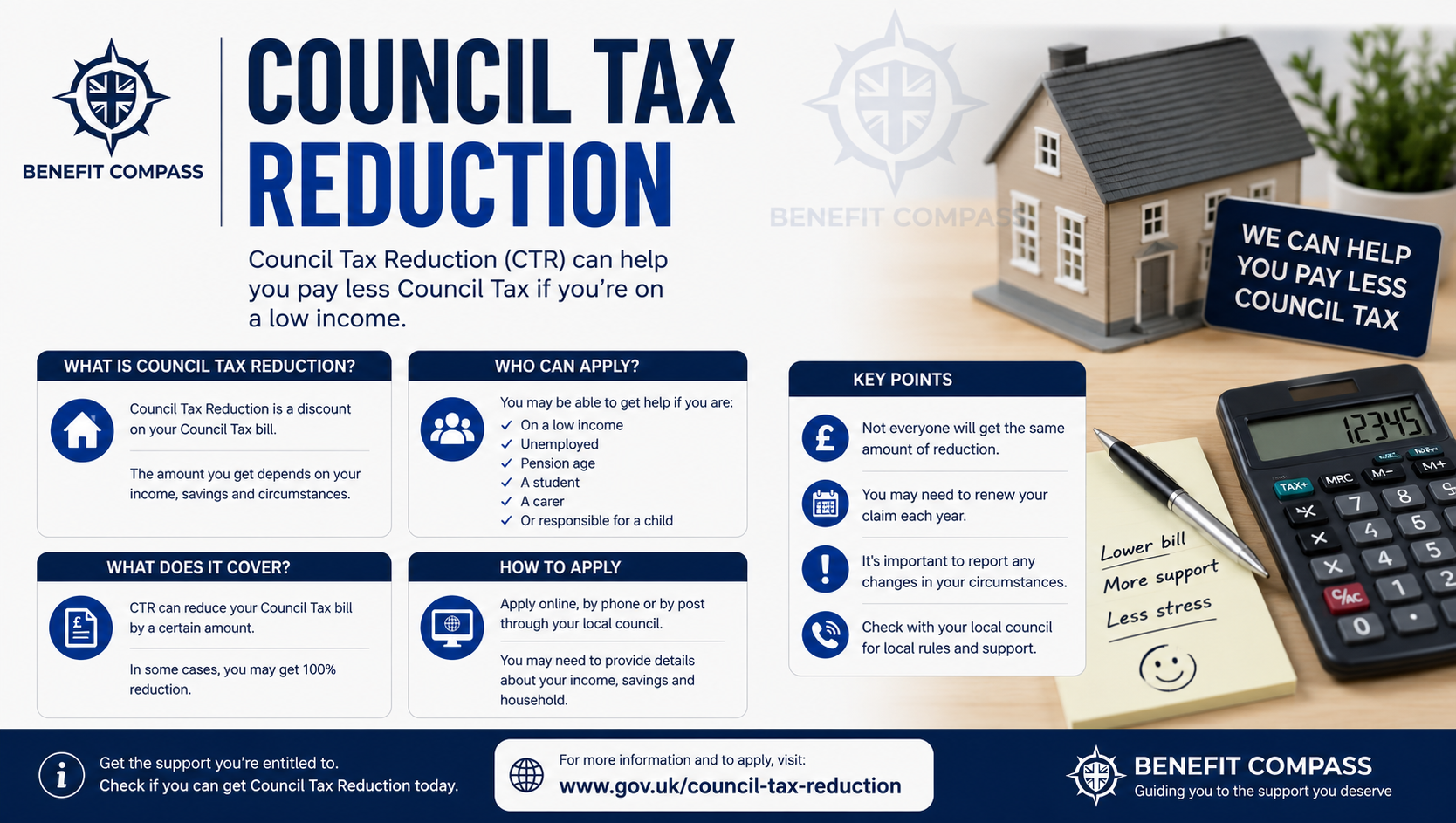
Council Tax Reduction (sometimes called Council Tax Support) is a discount on your council tax bill for people on a low income. It’s not a loan, and you don’t pay it back. Depending on your circumstances, it can knock anywhere from a small percentage off your bill to covering it completely.
Here’s the part that trips people up: unlike most UK benefits, Council Tax Reduction isn’t run nationally by the DWP. Each local council designs and manages its own scheme, which means the rules — and the amount you get — can differ depending on where you live.
Who Can Claim Council Tax Reduction?
You could be eligible whether you’re employed, unemployed, retired, or self-employed. Councils generally look at:
- Your income — including wages, benefits, and pensions
- Your savings — usually capped around £16,000, though pensioners sometimes have more flexibility
- Who lives with you — a partner’s income and other adults in the household (“non-dependants”) can affect your award
- Your council tax band — higher bands may mean a bigger bill, but reduction schemes still apply
- Your personal circumstances — such as disability, caring responsibilities, or being a single parent
People Who Often Qualify
- Pensioners on a low income or Pension Credit
- People receiving Universal Credit, Income Support, or Jobseeker’s Allowance
- Low-income working households, even without other benefits
- Full-time carers
- People with a disability, including those receiving PIP or DLA
Quick Example
Sarah is a single mum working part-time on a modest wage. She assumed Council Tax Reduction was only for people who don’t work — but because her income is low relative to her household size, her council reduced her bill by 60%. She only found out because she used her council’s online eligibility checker.
Council Tax Reduction Eligibility Checker: How It Works
Most councils now offer an online checker where you enter basic details — income, savings, household size, and postcode — and get an instant estimate of what you might be entitled to.
Here’s what you’ll typically need on hand before you start:
- Your National Insurance number
- Details of your income (payslips, benefit award letters, or pension statements)
- Savings and investment figures
- Details of anyone else living with you
- Your council tax account number, if you already have one
The checker gives you an estimate, not a guaranteed figure — your actual award depends on your council’s final assessment.
Read More: Universal Credit Eligibility Checker – Who Can Claim in 2026?
How Much Could You Save?
There’s no single UK-wide amount because every council sets its own rules. That said, here’s a general idea of what different groups often receive:
| Circumstance | Typical Reduction Range |
|---|---|
| Pension-age, low income | Up to 100% |
| Working-age, on Universal Credit | 20%–80% |
| Working-age, low earned income | 10%–60% |
| Single person discount (separate scheme) | 25% flat reduction |
| Full-time student household | Often 100% exempt |
Keep in mind: pension-age claimants are often protected by national minimum standards, while working-age schemes vary far more from council to council — some require a minimum payment regardless of income.
Step-by-Step: How to Apply for Council Tax Reduction
- Find your local council’s website — search “[your council name] council tax reduction” rather than going through a general benefits portal.
- Use the eligibility checker first — this saves time and gives you a realistic expectation before you commit to a full application.
- Gather your documents — proof of income, ID, tenancy agreement or mortgage statement, and details of household members.
- Complete the application form — most are online now, though phone and paper options usually still exist for those who need them.
- Submit and wait for a decision — processing times vary, but many councils aim for 2–4 weeks.
- Check your revised council tax bill — once approved, your council will send an updated bill reflecting the reduction.
If You’re Already Struggling to Pay
Don’t wait for your application to be approved before contacting your council if you’re behind on payments. Many councils will pause enforcement action while your claim is being processed, but only if you tell them.
Council Tax Reduction vs Other Council Tax Discounts
It’s easy to confuse Council Tax Reduction with other discounts, so here’s a quick breakdown:
| Discount Type | Who It’s For | Based on Income? |
|---|---|---|
| Council Tax Reduction | Low-income households | Yes |
| Single Person Discount | Sole adult occupiers | No |
| Disability Reduction Scheme | Homes adapted for a disabled resident | No |
| Student Exemption | Households of full-time students | No |
| Severe Mental Impairment Exemption | Qualifying individuals | No |
You can often claim more than one of these at the same time if you meet the criteria for each — for example, a single parent with a disability might qualify for both Council Tax Reduction and the Disability Reduction Scheme.
Common Reasons Applications Get Rejected
- Savings above the threshold — even modest savings can affect eligibility, especially for working-age claimants.
- Incomplete documentation — missing payslips or ID can delay or stall a decision.
- Not reporting a partner’s income — this is one of the most common causes of rejected or reduced awards.
- Applying to the wrong council — always apply to the council covering your current address, not a previous one.
If you’re rejected, you can ask for a formal review, and most councils have an appeals process if you still disagree with the outcome.
What Happens If Your Circumstances Change?
You must report changes to your council as soon as they happen, including:
- A change in income (higher or lower)
- Someone moving in or out of your home
- A change in benefit status
- Moving to a new address, even within the same council area
Reporting changes late can lead to overpayments, which you’ll usually have to pay back — so it’s worth doing this promptly rather than waiting for your next review.
Final Thoughts
Council Tax Reduction is one of those benefits that’s easy to overlook simply because it isn’t advertised the same way Universal Credit or Housing Benefit is. But if your income is low, or you’re a pensioner, single parent, or carer, it’s well worth five minutes on your council’s eligibility checker to see where you stand.
The rules differ by council, but the principle is the same everywhere: you shouldn’t be paying more council tax than your circumstances allow. If you haven’t checked recently, now’s a good time to do it.
FAQ’s
Is Council Tax Reduction the same across the whole UK?
No. Each local council designs its own scheme, so amounts and eligibility rules vary depending on where you live.
Can I get Council Tax Reduction if I’m working?
Yes. Many working households on a modest income qualify, though the amount depends on your council’s specific scheme.
Does Council Tax Reduction affect other benefits?
No, it doesn’t count as income and won’t reduce other benefits you receive.
Can pensioners get 100% Council Tax Reduction?
Yes, pensioners on a low income or receiving Pension Credit Guarantee Credit can sometimes have their bill covered in full.
How long does a Council Tax Reduction application take?
Most councils process applications within 2–4 weeks, though this can vary during busy periods.
Can I backdate my Council Tax Reduction claim?
Some councils allow backdating in certain circumstances, particularly for pension-age claimants — it’s worth asking directly.
What if I share my home with another adult who isn’t my partner?
Their income may be treated as a “non-dependant deduction,” which can reduce your award depending on their earnings.
Do I need to reapply every year?
Most councils carry out an annual review rather than requiring a fresh application, but you must report changes as they happen.
Can students claim Council Tax Reduction?
Full-time students are usually exempt from council tax altogether rather than needing a reduction, though rules differ for mixed households.
What happens if I miss a council tax payment while waiting for a decision?
Contact your council immediately — most will pause recovery action while your application is being assessed, but you need to inform them first.